
Pine Beetle Prevention in Centennial, Colorado
Protect your trees from bark beetle infestations in Centennial, Arapahoe County. Local prevention tips, risk assessment, and professional resources.
Elevation
5,763'
Population
111,331
County
Arapahoe
Primary Trees
Ponderosa Pine
CSFS Mountain Pine Beetle Activity — Arapahoe County
Documented
Active beetles in county
Adjacent
Nearby counties affected
Not Documented
No confirmed activity
Source: Colorado State Forest Service aerial surveys, 2024
Mountain Pine Beetle in Arapahoe County
Arapahoe County does not have CSFS-documented mountain pine beetle activity, but its proximity to affected counties — Douglas to the south and Jefferson to the west — means beetles could spread into the area.
Arapahoe County Details
While lower-elevation urban and suburban communities in Arapahoe County face less risk than foothill towns, Ips engraver beetles are increasingly active in Denver metro area pines. Drought-stressed landscape pines in communities like Centennial and Littleton remain vulnerable.
Key Finding
No confirmed MPB activity, but adjacent to multiple documented counties
Front Range Outbreak Trend
Acres of MPB-caused tree mortality, Front Range. Source: CSFS Aerial Surveys, 2020–2024
700K+
Acres of vulnerable pine along the Front Range
1,767%
Increase in affected acres, 2020–2024
Data sourced from Colorado State Forest Service aerial survey reports, forest health publications, and local reporting.
Pine Beetle Guide for Centennial, Colorado
Centennial is a large suburban city of over 111,000 residents in Arapahoe County, incorporated in 2001 from a collection of unincorporated neighborhoods sprawling across the high plains southeast of Denver at 5,763 feet. Unlike many Front Range communities defined by dramatic mountain terrain, Centennial is a thoroughly suburban landscape of residential subdivisions, shopping centers, and corporate campuses laid out along the arterials of Arapahoe Road, Dry Creek Road, and University Boulevard. Ponderosa Pine is present throughout Centennial but as a landscape element rather than a dominant forest type — individual specimens and small groupings dot residential lots, medians, parks, and office complexes. While this lower pine density limits the scale of potential beetle outbreaks, it does not eliminate the risk, and Centennial property owners with valued Ponderosa Pines should understand the threat.
Pine Beetle Risk in Centennial
Centennial is rated Moderate for pine beetle risk, reflecting its lower elevation, suburban character, and dispersed pine population.
At 5,763 feet, Centennial sits below the elevation where mountain pine beetle populations sustain themselves reliably. The city's beetle risk is almost entirely an Ips engraver beetle problem, driven by the urban stress factors that weaken landscape pines in suburban environments. However, the "Moderate" designation should not breed complacency — individual trees and neighborhoods with higher pine concentrations can experience significant losses during drought years.
Centennial's risk geography is not uniform. The southern portions of the city — neighborhoods like the Homestead Farm area, the subdivisions south of Arapahoe Road near Cherry Creek State Park, and the areas bordering Highlands Ranch — have higher pine density and slightly higher elevation, placing them closer to the High-risk threshold. The northern portions along Orchard Road and the Interstate 25 corridor have fewer pines and lower beetle pressure.
The city's soils are predominantly clay and clay-loam from the Denver Formation, supplemented by alluvial deposits along the Cherry Creek and Dry Creek drainages. These soils are dense, slow-draining, and shrink-swell with moisture changes — creating chronic challenges for Ponderosa Pine root systems. Trees planted in heavy clay during Centennial's suburban development decades often develop root girdling, restricted root zones, and moisture stress that makes them beetle-susceptible even when precipitation is near normal.
Centennial's extensive impervious surface coverage — roads, parking lots, driveways, sidewalks, and buildings — creates an urban heat island effect that raises local temperatures 3 to 5 degrees above surrounding rural areas. This warmth extends the Ips beetle breeding season and can push beetle populations to levels that overwhelm individual trees' defenses.
The city's development timeline is relevant. Centennial's neighborhoods were largely built between the 1960s and 1990s, and many Ponderosa Pines installed during construction are now 30 to 50 years old — mature enough to be attractive beetle hosts but also potentially weakened by decades of urban stress.
Prevention Tips for Centennial Properties
Centennial's Moderate risk and suburban environment allow a prevention strategy focused on urban tree health fundamentals rather than forest management.
Convert Turf to Mulch Under the Canopy: If your Ponderosa Pine is growing in a turf grass lawn — the default in most Centennial yards — you are forcing the tree to compete with grass for water and nutrients while its root zone bakes under the reflected heat of a mowed lawn. Converting the area under the canopy to a mulch bed is the single highest-impact change a Centennial homeowner can make. Maintain three to four inches of coarse organic mulch from six inches off the trunk to at least the drip line. Leave the six-inch gap at the trunk to prevent bark moisture problems (avoid "volcano mulching"). This change moderates soil temperature by 10 to 15 degrees in summer, reduces compaction, retains soil moisture, and eliminates turf competition. Trees surrounded by mulch beds in Centennial's clay soils show measurably improved crown density within two to three growing seasons.
Clay-Appropriate Watering Technique: Centennial's clay soils require a counterintuitive approach: water less frequently but more slowly than you would on sandy soils. A soaker hose at the drip line running at a bare trickle for three to four hours once monthly during dry periods (July through October, and again during dry winters in January through March) delivers water to root depth without saturating or ponding. Never use a sprinkler — the fast delivery rate causes runoff on clay surfaces. Overwatering is a genuine risk in Centennial's clay — waterlogged soil becomes anaerobic, damaging root function and paradoxically increasing drought stress by killing the fine absorptive roots.
Strict November-to-March Pruning: All Ponderosa Pine pruning in Centennial must occur during the dormant season. This is the single most controllable Ips beetle risk factor in a suburban setting. Communicate this standard to any tree service you hire and verify their scheduling before signing a contract. If your HOA contracts landscape maintenance, verify that the agreement specifies winter-only pine pruning. A single improperly timed pruning event on your property or a neighbor's can seed an Ips outbreak that threatens every Ponderosa in the neighborhood.
Prompt Removal of Declining Trees: In Centennial's suburban setting, a dead or slowly dying Ponderosa is primarily a beetle source for neighboring trees. Remove dead or chronically declining trees within one season of reaching the point of no return — less than 40 percent crown remaining, multiple years of progressive decline despite care, extensive branch flagging throughout the crown. The City of Centennial does not require permits for tree removal on private property, though you should check with your HOA if applicable.
Diversified Planting for New Landscapes: If adding trees to your Centennial property, avoid creating a monoculture of beetle-susceptible pines. Mix species — combine one or two Ponderosa Pines with deciduous trees and beetle-resistant conifers. Space new pines at least 20 feet apart canopy-to-canopy and select planting locations with the best available drainage. Amend clay soil with organic matter in a wide planting area rather than just the planting hole. A diverse landscape with scattered pines is inherently more beetle-resistant than a property planted with a row of Ponderosas.
Local Resources
- City of Centennial Public Works manages street trees and coordinates responses to tree health issues on city property. Contact them to report dead or declining pines on public land.
- Arapahoe County Extension Office (CSU Extension) provides tree health diagnostics and beetle identification at no cost. Bring bark samples, branch sections, or photos to their office for analysis and management recommendations.
- Cherry Creek State Park (adjacent to eastern Centennial) monitors tree health within the park and can provide context for beetle conditions near the Cherry Creek corridor.
- South Suburban Parks and Recreation manages parks and open spaces in Centennial containing Ponderosa Pine and conducts periodic health assessments of these trees.
- Colorado State Forest Service provides technical assistance on urban forestry challenges, including guidance on distinguishing beetle damage from other causes of tree decline in suburban settings.
- Centennial City Council's Environment Committee periodically addresses tree canopy and urban forest issues — attend meetings when forest health topics are on the agenda to stay informed and voice support for proactive management.
Nearby Affected Areas
Centennial is bordered by communities with varying beetle risk levels. Highlands Ranch to the south carries a High risk rating, and its more heavily forested landscape can produce beetles that drift northward into Centennial's southern neighborhoods. Lone Tree to the southwest shares a similar suburban profile. Littleton to the west faces Moderate risk along the South Platte corridor. Parker to the southeast has High risk in its Ponderosa Pine-rich subdivisions. Denver to the north faces Moderate risk with similar urban beetle challenges. Centennial's position in this ring of communities means that regional beetle conditions affect local pressure, even if the city's own pine density limits the scale of potential outbreaks.
Common Pine Beetle Species in Colorado
Three bark beetle species pose the greatest threat to pine trees in Centennial and across Colorado's Front Range.
Mountain Pine Beetle
Dendroctonus ponderosae
The primary killer of Ponderosa and Lodgepole pines along the Front Range. Adults are black, about the size of a grain of rice (5mm). They use aggregation pheromones to coordinate mass attacks that overwhelm a tree's pitch defenses.
- ● Targets trees 8"+ diameter
- ● One generation per year (July–August flight)
- ● Carries blue stain fungus that blocks water transport
- ● Creates J-shaped egg galleries under bark
Ips Engraver Beetle
Ips pini
A smaller, opportunistic beetle that exploits any weakness: drought stress, pruning wounds, fresh slash piles, or construction damage to roots. Less dramatic than MPB but persistent and hard to prevent entirely.
- ● Attacks trees of any size, including limbs
- ● 2–3 generations per year (April–October)
- ● Creates Y-shaped egg galleries under bark
- ● Often the first beetle to attack stressed trees
Red Turpentine Beetle
Dendroctonus valens
The largest bark beetle in North America (up to 10mm). Typically attacks the lower trunk of weakened or injured trees. Rarely kills trees on its own but signals stress that can attract MPB and Ips beetles.
- ● Attacks lower 6 feet of trunk
- ● Produces large, quarter-sized pitch tubes
- ● Indicator species for tree stress
- ● Often found after construction or root damage
Species data: Colorado State Forest Service, USDA Forest Service
Signs of Pine Beetle Infestation
Knowing what to look for is the first step to protecting your Centennial property. Here are the key warning signs every homeowner should monitor.
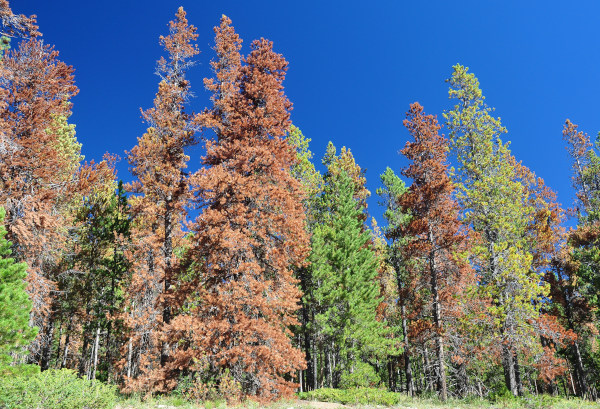
Fading or Discoloring Needles
Healthy green needles that turn yellowish, then rusty red. By the time an entire crown is red, the beetles have typically already exited the tree and moved to new hosts.
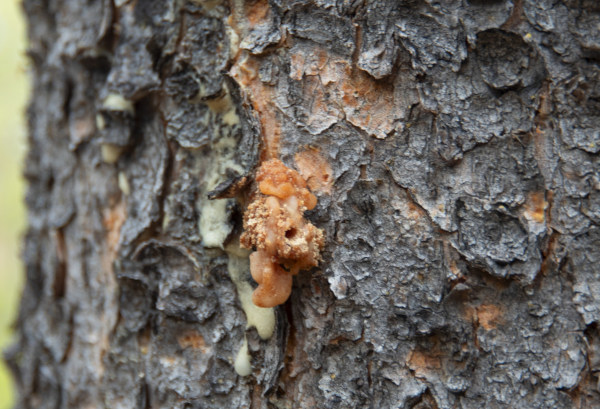
Pitch Tubes on the Trunk
Small, popcorn-shaped masses of resin on the bark surface. These form when the tree tries to "pitch out" boring beetles. Reddish-brown pitch tubes indicate a failed defense.
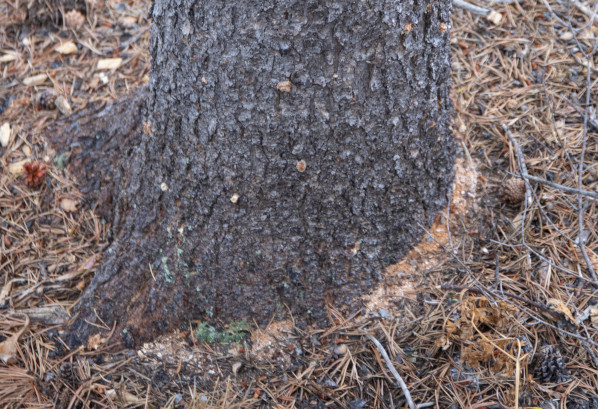
Boring Dust (Frass)
Fine, reddish-brown sawdust accumulating in bark crevices, around the base of the tree, and on spider webs nearby. This indicates active beetle tunneling beneath the bark.
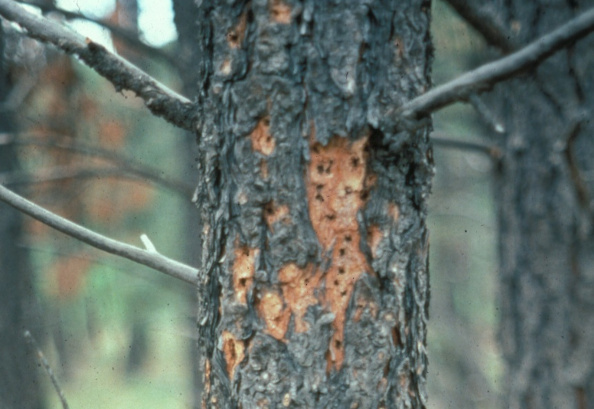
Woodpecker Activity
Heavy woodpecker feeding on trunk and branches strips bark as they search for beetle larvae. Large patches of light-colored, exposed wood are a telltale sign of severe infestation.
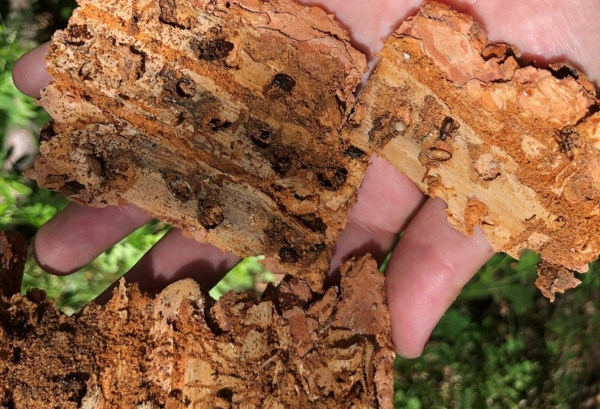
J-Shaped Galleries Under Bark
Peel back a small section of loose bark to reveal tunneling patterns. Mountain pine beetles create distinctive J- or Y-shaped egg galleries carved into the inner bark.
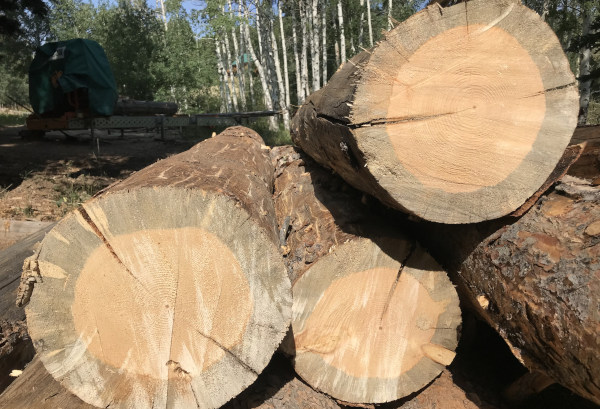
Blue Stain Fungus
Beetles carry blue stain fungus that blocks the tree's water-conducting tissues. Cross-cut sections of affected wood show distinctive blue-gray streaking through the sapwood.
Photos: Colorado State Forest Service
Nearby Front Range Communities
Latest from the Blog
View All →
Colorado's 2026 Pine Beetle Response: Task Force, Funding, and What It Means for Homeowners
Governor Polis created a statewide task force, Jefferson County launched a $500K cost-share program, and the legislature is funding biological controls. Here's what Colorado is actually doing about the pine beetle outbreak — and what homeowners need to know.

Colorado's Ponderosa Mountain Pine Beetle Task Force: What It Is, Who's Behind It, and What It Means for the Front Range
Colorado's Ponderosa Mountain Pine Beetle Task Force was created to fight the expanding Front Range outbreak. Here's what the task force is doing and what it means for you.