
Pine Beetle Prevention in Evergreen, Colorado
Protect your trees from bark beetle infestations in Evergreen, Jefferson County. Local prevention tips, risk assessment, and professional resources.
Elevation
7,220'
Population
9,557
County
Jefferson
Primary Trees
Ponderosa Pine, Lodgepole Pine
CSFS Mountain Pine Beetle Activity — Jefferson County
Documented
Active beetles in county
Adjacent
Nearby activity
Not Documented
No confirmed activity
Source: Colorado State Forest Service aerial surveys, 2024
Mountain Pine Beetle in Jefferson County
Jefferson County has documented approximately 20 acres of visible ponderosa pine mortality near I-70 and Soda Creek Road, with active treatment programs underway at Elk Meadow and Meyer Ranch parks.
Jefferson County Details
Jeffco Parks and Open Space treated 21+ acres at Elk Meadow Park in 2025, removing 45+ loads of infected logs. An additional 185 acres of mixed-conifer treatment is planned at Meyer Ranch Park for summer 2026. A new landowner cost-assistance program for MPB mitigation launches in 2026. Commissioner Lesley Dahlkemper serves on the state Pine Beetle Task Force.
Key Finding
21+ acres treated at Elk Meadow Park; 185-acre treatment planned at Meyer Ranch for 2026
Front Range Outbreak Trend
Acres of MPB-caused tree mortality, Front Range. Source: CSFS Aerial Surveys, 2020–2024
700K+
Acres of vulnerable pine along the Front Range
1,767%
Increase in affected acres, 2020–2024
Data sourced from Colorado State Forest Service aerial survey reports, forest health publications, and local reporting.
Pine Beetle Guide for Evergreen, Colorado
Evergreen is a mountain community of approximately 9,557 residents in Jefferson County, situated at 7,220 feet in a broad valley where Bear Creek emerges from the foothills west of Denver. The town is centered around Evergreen Lake — a reservoir built in the 1920s that is now a beloved recreational landmark — and spreads up the surrounding mountainsides through a web of winding roads, forested subdivisions, and scattered acreages. Evergreen's landscape is defined by dense mixed conifer forest, with Ponderosa Pine dominating the south-facing slopes and lower elevations while Lodgepole Pine and Douglas Fir take over on north-facing aspects and higher ground. This rich forest tapestry, combined with the community's deep mountain character, creates both Evergreen's appeal and its most serious environmental challenge.
Pine Beetle Risk in Evergreen
Evergreen holds a Critical pine beetle risk designation, reflecting the community's exceptional vulnerability to bark beetle outbreaks across its mixed conifer forest.
At 7,220 feet, Evergreen sits squarely in the mountain pine beetle's optimal elevation range for both Ponderosa and Lodgepole Pine host species. The community's dual-host forest composition means beetles have access to two suitable pine species across a continuous landscape. South-facing slopes covered in Ponderosa Pine transition into north-facing Lodgepole stands, creating an unbroken canopy of susceptible host trees that stretches in every direction.
Evergreen's position in the Bear Creek watershed places it at the convergence of several forested drainages — Bear Creek, Cub Creek, and their tributaries — each lined with dense pine forest. These drainages serve as natural corridors for beetle dispersal, channeling beetles from higher-elevation forests in the Mount Evans corridor down through the community. The Mount Evans Wilderness and the Arapaho National Forest to the west have experienced repeated mountain pine beetle epidemics, and Evergreen sits directly in the dispersal path.
The community's development pattern amplifies beetle risk. Evergreen was largely developed between the 1960s and 1980s by building homes within existing forest stands, preserving trees at near-natural densities. Many Evergreen properties feature 50 to 100 or more pines per acre — densities that far exceed what beetle-resistant management prescribes. The steep terrain makes access for thinning equipment difficult, and the community's aesthetic attachment to its forest density has historically slowed thinning efforts.
Evergreen's soils are predominantly decomposed granite — thin, rocky, and extremely well-drained. These soils support robust Ponderosa Pine growth during normal precipitation years but provide virtually no moisture buffer during drought. The drought cycles of 2002, 2012, and 2020 each triggered significant beetle-related tree mortality in the Evergreen area.
Prevention Tips for Evergreen Properties
Evergreen's Critical risk designation requires a lifestyle-level commitment to forest health management. Residents who maintain their forest actively year after year protect their homes and property values; those who defer the work face inevitable, expensive losses.
Defensible Space as Dual-Purpose Strategy: The Evergreen Fire Protection District has been a national leader in defensible space programming for decades. Embrace their guidance fully, understanding that every defensible space action simultaneously reduces beetle vulnerability. Thinning trees creates defensible space and reduces tree competition for water. Removing slash eliminates fire fuel and beetle breeding habitat. Creating separation between canopy layers reduces fire ladder fuels and improves air circulation that helps trees dry after rain. A properly implemented defensible space plan around your Evergreen home is one of the most effective beetle prevention investments available.
Species-Prioritized Thinning in Mixed Stands: In Evergreen's mixed Ponderosa-Lodgepole forest, thinning decisions should favor retaining Ponderosa over Lodgepole where both species are present in the same area. Ponderosa Pine is more drought-tolerant, produces more defensive pitch per unit of bark area, develops thicker bark as it matures, and is generally more fire-resistant. In a mixed stand, removing Lodgepole to reduce overall density while preserving Ponderosa shifts the remaining forest toward the more beetle-resistant species. Target 50 to 60 trees per acre in Ponderosa-dominated zones and 60 to 80 per acre in Lodgepole zones. Begin within 100 feet of structures and work outward.
Watering on Granite Soils with Limited Well Capacity: Evergreen's decomposed granite soils shed moisture within days of a watering event, and most properties depend on wells with limited output. Rather than trying to water every tree, identify your 10 to 15 highest-priority Ponderosas — those closest to your home, providing the most shade, and in the best current health — and focus your limited water exclusively on them. A soaker hose at the drip line delivering a slow soak for four to six hours monthly during dry periods from October through May builds the pitch reserves that determine whether a tree survives beetle flight season. Accept that you cannot irrigate the entire forest and make strategic choices about which trees to invest in.
Community Slash Coordination: After thinning, every pine branch and trunk section left on-site during warm months becomes a beetle incubator. Evergreen Fire Protection District coordinates periodic community slash collection events, and the Evergreen Park and Recreation District has facilitated community chipping days. Schedule your thinning work to align with these community collection windows. If no community event is upcoming, hire a chipper or haul slash to an approved disposal site within two weeks of cutting. The cost of slash disposal is part of the cost of thinning — budget for it from the start.
Annual Preventive Spray for Interface Trees: For Ponderosas within 75 feet of your home — the trees whose loss would directly affect your living space, your property value, and your fire risk — annual preventive spraying with carbaryl provides the most reliable individual-tree protection. In Evergreen, apply between late April and mid-June; the higher elevation pushes beetle flight slightly later than foothill communities. For Lodgepole Pine near your home, discuss systemic trunk injection with a licensed arborist as an alternative, since Lodgepole's thin bark retains surface sprays less effectively than Ponderosa's thick bark.
Local Resources
- Evergreen Fire Protection District provides free defensible space assessments that fully integrate beetle management, coordinates community thinning programs, and has been a regional leader in wildfire and forest health management for decades. Start here.
- Jefferson County Open Space manages thousands of acres of forest adjacent to Evergreen residential areas and conducts active beetle monitoring and forest health management. Their observations on county land provide early warning for pressure on neighboring private properties.
- Evergreen Park and Recreation District manages community parks and has facilitated community slash collection and chipping days. Check their schedule for upcoming events.
- Colorado State Forest Service — Golden District covers Jefferson County and provides technical assistance, beetle identification, forest management planning, and cost-sharing programs for private landowners in the Evergreen area.
- Mount Evans and Arapaho National Forest manage the federal lands west of Evergreen. Their beetle monitoring data contextualizes the pressure flowing toward Evergreen from the higher-elevation forest.
- Clear Creek Watershed Foundation coordinates watershed health initiatives in the Bear Creek and Clear Creek drainages, including forest health components relevant to Evergreen properties.
Nearby Affected Areas
Evergreen is part of a band of mountain communities in Jefferson County facing Critical beetle risk. Conifer to the southwest, at even higher elevation, shares the same mixed conifer forest and Critical risk profile. Morrison to the east, at the mouth of Bear Creek Canyon, faces High risk as the forest transitions to the foothills. Golden to the northeast manages Moderate risk in its foothill-adjacent neighborhoods. To the west, the mountain communities of Idaho Springs and Georgetown have experienced devastating mountain pine beetle and spruce beetle outbreaks. The forested corridor from Evergreen through Conifer to Bailey represents one of the most beetle-vulnerable residential zones in Colorado, and management efforts in any one community benefit the entire corridor.
Common Pine Beetle Species in Colorado
Three bark beetle species pose the greatest threat to pine trees in Evergreen and across Colorado's Front Range.
Mountain Pine Beetle
Dendroctonus ponderosae
The primary killer of Ponderosa and Lodgepole pines along the Front Range. Adults are black, about the size of a grain of rice (5mm). They use aggregation pheromones to coordinate mass attacks that overwhelm a tree's pitch defenses.
- ● Targets trees 8"+ diameter
- ● One generation per year (July–August flight)
- ● Carries blue stain fungus that blocks water transport
- ● Creates J-shaped egg galleries under bark
Ips Engraver Beetle
Ips pini
A smaller, opportunistic beetle that exploits any weakness: drought stress, pruning wounds, fresh slash piles, or construction damage to roots. Less dramatic than MPB but persistent and hard to prevent entirely.
- ● Attacks trees of any size, including limbs
- ● 2–3 generations per year (April–October)
- ● Creates Y-shaped egg galleries under bark
- ● Often the first beetle to attack stressed trees
Red Turpentine Beetle
Dendroctonus valens
The largest bark beetle in North America (up to 10mm). Typically attacks the lower trunk of weakened or injured trees. Rarely kills trees on its own but signals stress that can attract MPB and Ips beetles.
- ● Attacks lower 6 feet of trunk
- ● Produces large, quarter-sized pitch tubes
- ● Indicator species for tree stress
- ● Often found after construction or root damage
Species data: Colorado State Forest Service, USDA Forest Service
Signs of Pine Beetle Infestation
Knowing what to look for is the first step to protecting your Evergreen property. Here are the key warning signs every homeowner should monitor.
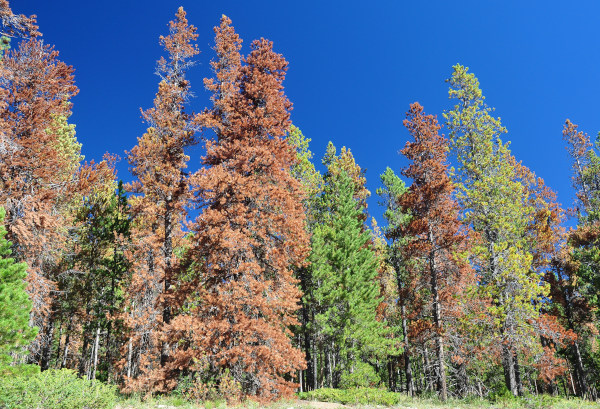
Fading or Discoloring Needles
Healthy green needles that turn yellowish, then rusty red. By the time an entire crown is red, the beetles have typically already exited the tree and moved to new hosts.
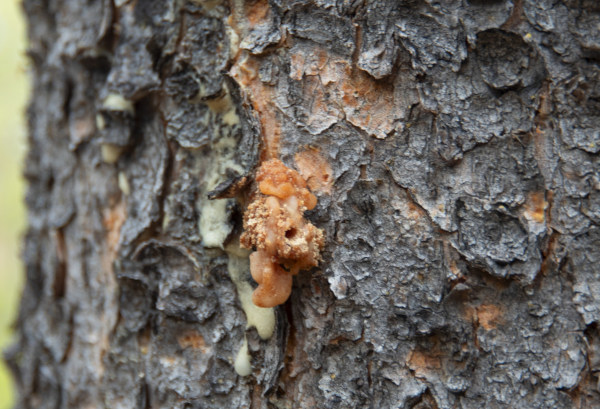
Pitch Tubes on the Trunk
Small, popcorn-shaped masses of resin on the bark surface. These form when the tree tries to "pitch out" boring beetles. Reddish-brown pitch tubes indicate a failed defense.
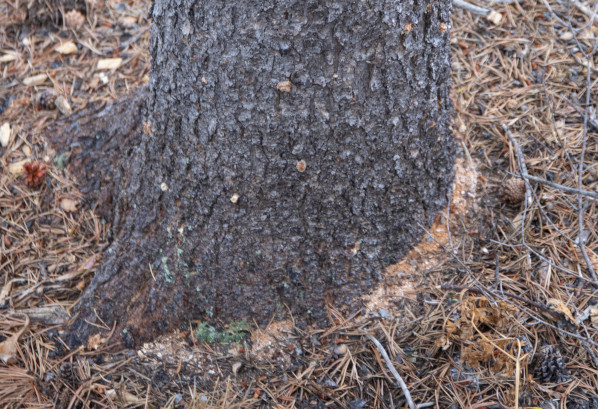
Boring Dust (Frass)
Fine, reddish-brown sawdust accumulating in bark crevices, around the base of the tree, and on spider webs nearby. This indicates active beetle tunneling beneath the bark.
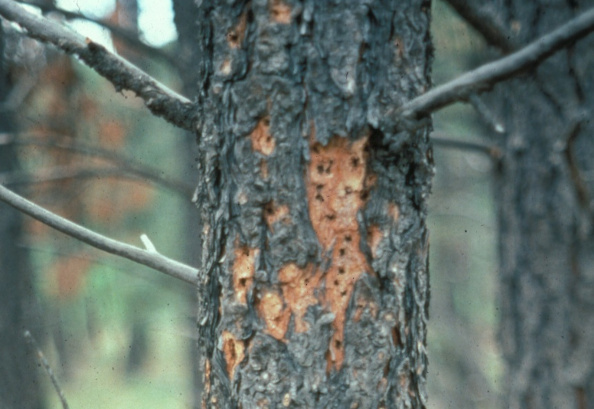
Woodpecker Activity
Heavy woodpecker feeding on trunk and branches strips bark as they search for beetle larvae. Large patches of light-colored, exposed wood are a telltale sign of severe infestation.
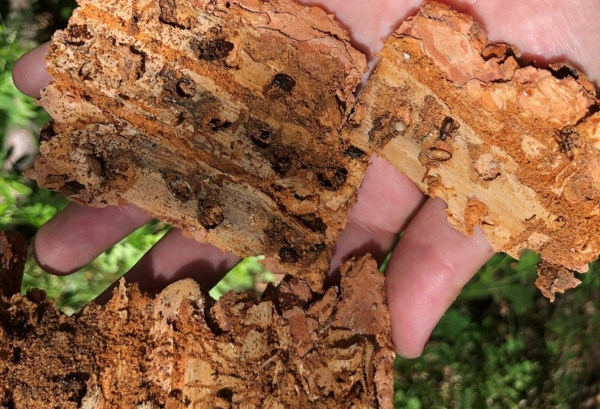
J-Shaped Galleries Under Bark
Peel back a small section of loose bark to reveal tunneling patterns. Mountain pine beetles create distinctive J- or Y-shaped egg galleries carved into the inner bark.
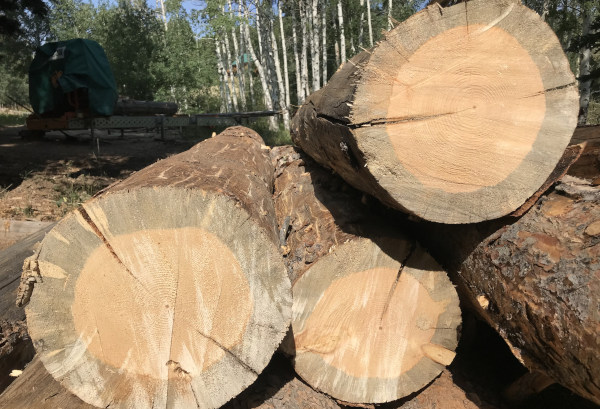
Blue Stain Fungus
Beetles carry blue stain fungus that blocks the tree's water-conducting tissues. Cross-cut sections of affected wood show distinctive blue-gray streaking through the sapwood.
Photos: Colorado State Forest Service
Nearby Front Range Communities
Latest from the Blog
View All →
Colorado's 2026 Pine Beetle Response: Task Force, Funding, and What It Means for Homeowners
Governor Polis created a statewide task force, Jefferson County launched a $500K cost-share program, and the legislature is funding biological controls. Here's what Colorado is actually doing about the pine beetle outbreak — and what homeowners need to know.

Colorado's Ponderosa Mountain Pine Beetle Task Force: What It Is, Who's Behind It, and What It Means for the Front Range
Colorado's Ponderosa Mountain Pine Beetle Task Force was created to fight the expanding Front Range outbreak. Here's what the task force is doing and what it means for you.