
Pine Beetle Prevention in Morrison, Colorado
Protect your trees from bark beetle infestations in Morrison, Jefferson County. Local prevention tips, risk assessment, and professional resources.
Elevation
5,800'
Population
460
County
Jefferson
Primary Trees
Ponderosa Pine
CSFS Mountain Pine Beetle Activity — Jefferson County
Documented
Active beetles in county
Adjacent
Nearby activity
Not Documented
No confirmed activity
Source: Colorado State Forest Service aerial surveys, 2024
Mountain Pine Beetle in Jefferson County
Jefferson County has documented approximately 20 acres of visible ponderosa pine mortality near I-70 and Soda Creek Road, with active treatment programs underway at Elk Meadow and Meyer Ranch parks.
Jefferson County Details
Jeffco Parks and Open Space treated 21+ acres at Elk Meadow Park in 2025, removing 45+ loads of infected logs. An additional 185 acres of mixed-conifer treatment is planned at Meyer Ranch Park for summer 2026. A new landowner cost-assistance program for MPB mitigation launches in 2026. Commissioner Lesley Dahlkemper serves on the state Pine Beetle Task Force.
Key Finding
21+ acres treated at Elk Meadow Park; 185-acre treatment planned at Meyer Ranch for 2026
Front Range Outbreak Trend
Acres of MPB-caused tree mortality, Front Range. Source: CSFS Aerial Surveys, 2020–2024
700K+
Acres of vulnerable pine along the Front Range
1,767%
Increase in affected acres, 2020–2024
Data sourced from Colorado State Forest Service aerial survey reports, forest health publications, and local reporting.
Pine Beetle Guide for Morrison, Colorado
Morrison is a tiny historic town of approximately 460 residents in Jefferson County, tucked into the mouth of Bear Creek Canyon at 5,800 feet where the hogback formations mark the dramatic transition from the Great Plains to the Rocky Mountain foothills. Famous for Red Rocks Amphitheatre and the striking tilted sandstone formations of the Dakota Hogback, Morrison occupies a landscape of extraordinary geological drama. The town's narrow footprint along Bear Creek is flanked by steep, pine-forested slopes that climb rapidly westward into the mountains toward Evergreen and Conifer. Ponderosa Pine is the dominant tree on the sun-baked south-facing slopes and ridge crests surrounding the town, while cottonwoods and willows line the Bear Creek riparian corridor through the town center. Morrison's position as the gateway to the mountain communities makes it a frontline interface between urban Denver and the beetle-impacted mountain forests.
Pine Beetle Risk in Morrison
Morrison is rated High for pine beetle risk, a designation that reflects both the town's own Ponderosa Pine vulnerability and its role as the receiving end of beetle dispersal from the heavily infested mountain communities above it.
At 5,800 feet, Morrison sits at the lower boundary of consistent mountain pine beetle habitat, but its canyon setting and steep, forested terrain create conditions more similar to higher-elevation communities than its nominal altitude would suggest. The narrow Bear Creek Canyon funnels wind, temperature gradients, and — critically — beetle flight patterns from the mountain forests of Evergreen and Conifer directly into Morrison. Beetles emerging from infested trees at 7,000 to 8,000 feet ride downslope air currents through the canyon and arrive in Morrison with each summer flight season.
The slopes surrounding Morrison feature some of the most sun-exposed Ponderosa Pine habitat on the Front Range. South- and west-facing hillsides above the town receive intense solar radiation that stresses trees during summer, accelerates evapotranspiration, and raises bark surface temperatures to levels that favor beetle activity. These hot, dry slope conditions create a microclimate warmer than Morrison's elevation would normally produce.
Morrison's soils are a complex mix of materials reflecting the geological diversity of the hogback environment — sandstone-derived sandy soils on the ridges, clay-rich shale soils in the valleys, and thin, rocky decomposed granite on the foothills slopes. Ponderosa Pines growing on the sandy ridge soils face drought stress during dry periods, while those on clay valley soils struggle with drainage. Neither substrate provides ideal growing conditions, leaving the town's pine population chronically stressed.
The 1978 Morrison Fire and several smaller fire events have periodically thinned the pine forest on the slopes above town, creating a patchwork of age classes. Some of the regrowth forests from these fires are now reaching the size class preferred by mountain pine beetles.
Jefferson County Open Space manages several parcels adjacent to Morrison — including Mount Falcon, Matthews/Winters, and Red Rocks — where Ponderosa Pine health is actively monitored and managed. Beetle conditions on these public lands directly affect the town.
Prevention Tips for Morrison Properties
Morrison's tiny size and tight-knit community make coordinated, whole-town prevention not just possible but necessary — a beetle outbreak in any part of Morrison affects every property.
Heat Mitigation for Sun-Exposed Trees: Morrison's canyon microclimate bakes south-facing Ponderosas with reflected heat from rock formations, retaining walls, pavement, and the sandstone hogback itself. For valued trees on hot exposures, mulch heavily — four to six inches of coarse organic material from trunk to drip line — to insulate root zones from surface heat. On the hottest sites, consider temporary shade structures or shade cloth during peak summer months if feasible. The goal is reducing soil temperature around roots, which reduces evaporative water loss and helps the tree maintain the moisture needed for pitch production.
Site-Specific Watering Approaches: Morrison's mixed-geology soils require different watering strategies depending on where your trees grow. For Ponderosas on the sandy ridge soils above town, water deeply once monthly during dry periods using a soaker hose at the drip line for four to six hours. For trees on the clay valley soils along Bear Creek, water less frequently — every six weeks — at a much slower rate to allow clay absorption without ponding. Trees near Bear Creek itself may need supplemental watering only during severe drought, as they benefit from shallow groundwater. Tailor your approach to each tree's specific site rather than applying a uniform schedule.
Coordinate with Jefferson County Open Space: Much of the forested land surrounding Morrison is publicly managed by Jefferson County. Engage with their Open Space division about beetle conditions on Mount Falcon, Matthews/Winters, and Red Rocks parcels. Report dead or dying trees on public land promptly. When the county conducts thinning or treatment on adjacent public land, coordinate your own property management to create continuous zones of reduced beetle habitat.
Town-Wide Pruning Timing Agreement: In a community of 460 people, a single improperly timed pruning event can affect the entire town's beetle risk. Advocate through the Town of Morrison government for a community-wide policy requiring November-through-March-only pruning for all Ponderosa Pine. In Morrison's small-town governance structure, this kind of policy can be adopted relatively quickly with community support. Share the reasoning with neighbors — most will comply once they understand the connection between summer pruning and beetle attraction.
Slope Thinning by Hand Crew: Morrison's steep terrain above the town makes mechanized thinning impractical on most properties. Plan for hand-crew work — workers with chainsaws rather than machines — which is more expensive per acre but the only viable approach on 40-to-60-degree slopes. Target 50 to 70 trees per acre on the slopes above your home, removing the weakest and most crowded individuals while retaining the largest, most vigorous Ponderosas. Their larger size provides both better beetle resistance (more pitch capacity) and greater landscape and shade value.
Local Resources
- Jefferson County Open Space manages Mount Falcon, Matthews/Winters, Red Rocks, and other parcels surrounding Morrison, conducting active forest health monitoring and beetle management. They are the primary public land manager affecting Morrison's beetle conditions.
- Lookout Mountain Fire Protection District serves the Morrison area and provides defensible space assessments that include beetle-killed tree removal and forest thinning recommendations.
- Town of Morrison can coordinate community-level responses to beetle threats, facilitate communication among the town's small number of property owners, and adopt local policies supporting beetle prevention.
- Denver Mountain Parks manages Red Rocks Park and other parkland near Morrison. Their forestry team monitors tree health in these high-visibility public spaces.
- Colorado State Forest Service — Golden District provides technical assistance, beetle identification, and cost-sharing programs for Jefferson County property owners, including Morrison residents.
- Bear Creek Watershed Association coordinates watershed health initiatives including forest management along the Bear Creek corridor through Morrison.
Nearby Affected Areas
Morrison sits at the nexus of mountain and urban beetle dynamics. Evergreen to the west, up Bear Creek Canyon, faces Critical risk with its dense mixed conifer forest — beetles from Evergreen disperse downcanyon into Morrison throughout the summer. Conifer to the southwest carries the same Critical designation at even higher elevation. Golden to the north shares Morrison's foothills setting and Moderate-to-High beetle risk. Lakewood to the east represents the transition to suburban Moderate risk. Littleton to the southeast faces Moderate risk in its foothill-adjacent areas. Morrison's role as the canyon gateway means its beetle conditions are a bellwether for the spread of mountain beetle populations into the urban foothills.
Common Pine Beetle Species in Colorado
Three bark beetle species pose the greatest threat to pine trees in Morrison and across Colorado's Front Range.
Mountain Pine Beetle
Dendroctonus ponderosae
The primary killer of Ponderosa and Lodgepole pines along the Front Range. Adults are black, about the size of a grain of rice (5mm). They use aggregation pheromones to coordinate mass attacks that overwhelm a tree's pitch defenses.
- ● Targets trees 8"+ diameter
- ● One generation per year (July–August flight)
- ● Carries blue stain fungus that blocks water transport
- ● Creates J-shaped egg galleries under bark
Ips Engraver Beetle
Ips pini
A smaller, opportunistic beetle that exploits any weakness: drought stress, pruning wounds, fresh slash piles, or construction damage to roots. Less dramatic than MPB but persistent and hard to prevent entirely.
- ● Attacks trees of any size, including limbs
- ● 2–3 generations per year (April–October)
- ● Creates Y-shaped egg galleries under bark
- ● Often the first beetle to attack stressed trees
Red Turpentine Beetle
Dendroctonus valens
The largest bark beetle in North America (up to 10mm). Typically attacks the lower trunk of weakened or injured trees. Rarely kills trees on its own but signals stress that can attract MPB and Ips beetles.
- ● Attacks lower 6 feet of trunk
- ● Produces large, quarter-sized pitch tubes
- ● Indicator species for tree stress
- ● Often found after construction or root damage
Species data: Colorado State Forest Service, USDA Forest Service
Signs of Pine Beetle Infestation
Knowing what to look for is the first step to protecting your Morrison property. Here are the key warning signs every homeowner should monitor.
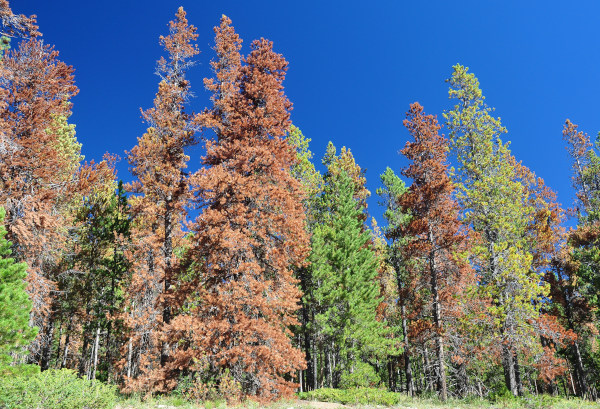
Fading or Discoloring Needles
Healthy green needles that turn yellowish, then rusty red. By the time an entire crown is red, the beetles have typically already exited the tree and moved to new hosts.
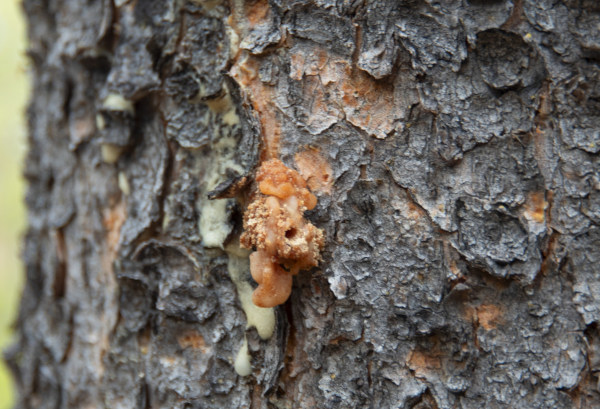
Pitch Tubes on the Trunk
Small, popcorn-shaped masses of resin on the bark surface. These form when the tree tries to "pitch out" boring beetles. Reddish-brown pitch tubes indicate a failed defense.
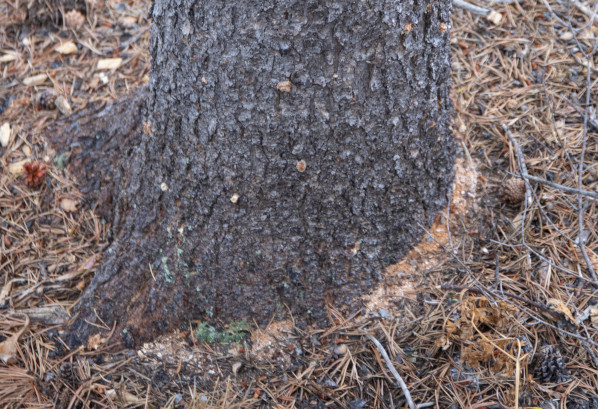
Boring Dust (Frass)
Fine, reddish-brown sawdust accumulating in bark crevices, around the base of the tree, and on spider webs nearby. This indicates active beetle tunneling beneath the bark.
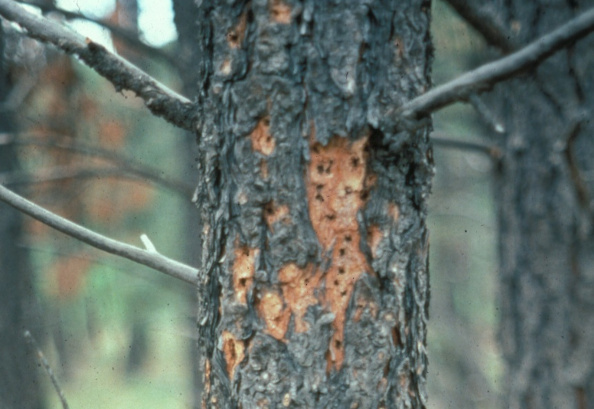
Woodpecker Activity
Heavy woodpecker feeding on trunk and branches strips bark as they search for beetle larvae. Large patches of light-colored, exposed wood are a telltale sign of severe infestation.
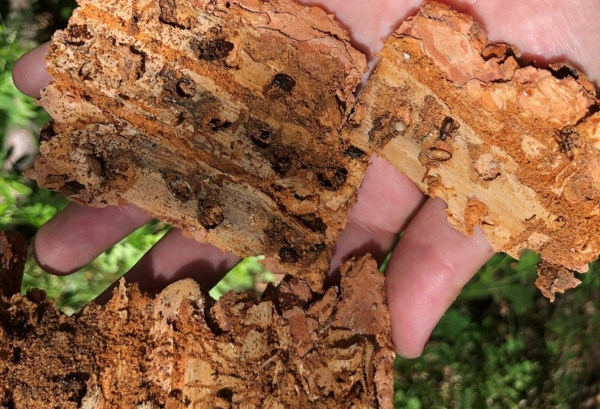
J-Shaped Galleries Under Bark
Peel back a small section of loose bark to reveal tunneling patterns. Mountain pine beetles create distinctive J- or Y-shaped egg galleries carved into the inner bark.
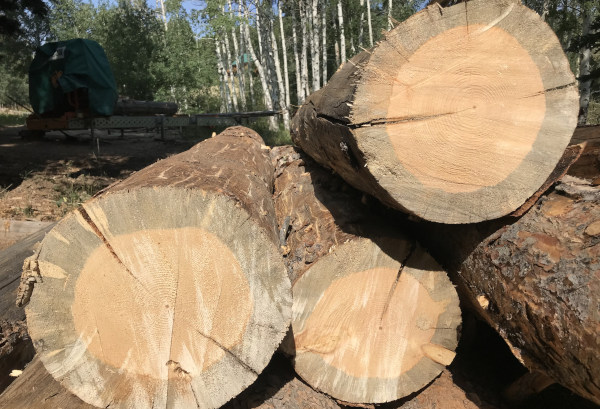
Blue Stain Fungus
Beetles carry blue stain fungus that blocks the tree's water-conducting tissues. Cross-cut sections of affected wood show distinctive blue-gray streaking through the sapwood.
Photos: Colorado State Forest Service
Nearby Front Range Communities
Latest from the Blog
View All →
Colorado's 2026 Pine Beetle Response: Task Force, Funding, and What It Means for Homeowners
Governor Polis created a statewide task force, Jefferson County launched a $500K cost-share program, and the legislature is funding biological controls. Here's what Colorado is actually doing about the pine beetle outbreak — and what homeowners need to know.

Colorado's Ponderosa Mountain Pine Beetle Task Force: What It Is, Who's Behind It, and What It Means for the Front Range
Colorado's Ponderosa Mountain Pine Beetle Task Force was created to fight the expanding Front Range outbreak. Here's what the task force is doing and what it means for you.