
Pine Beetle Prevention in Monument, Colorado
Protect your trees from bark beetle infestations in Monument, El Paso County. Local prevention tips, risk assessment, and professional resources.
Elevation
6,976'
Population
8,264
County
El Paso
Primary Trees
Ponderosa Pine
CSFS Mountain Pine Beetle Activity — El Paso County
Documented
Active beetles in county
Adjacent
Nearby activity
Not Documented
No confirmed activity
Source: Colorado State Forest Service aerial surveys, 2024
Mountain Pine Beetle in El Paso County
El Paso County represents the southern extent of the Front Range MPB outbreak, with documented beetle activity in ponderosa pine forests from Black Forest through Monument and into the western foothills near Colorado Springs.
El Paso County Details
The 2013 Black Forest Fire already demonstrated the catastrophic fire risk in El Paso County's pine forests. Now beetle-killed trees are adding to fuel loads in the same communities. Teller County Commissioner Dan Williams, from neighboring Cripple Creek, serves on the state Pine Beetle Task Force.
Key Finding
Southern extent of the Front Range outbreak; compounding fire risk from 2013 Black Forest Fire legacy
Front Range Outbreak Trend
Acres of MPB-caused tree mortality, Front Range. Source: CSFS Aerial Surveys, 2020–2024
700K+
Acres of vulnerable pine along the Front Range
1,767%
Increase in affected acres, 2020–2024
Data sourced from Colorado State Forest Service aerial survey reports, forest health publications, and local reporting.
Pine Beetle Guide for Monument, Colorado
Monument is a small town of roughly 8,264 residents in northern El Paso County, standing at 6,976 feet on the southern slope of the Palmer Divide. Named for a distinctive rock formation visible from the original Denver & Rio Grande Railway, Monument occupies a landscape of red rock outcrops, scrub oak hillsides, and dense Ponderosa Pine forests that stretch westward toward the Rampart Range. The town's neighborhoods — including Promontory Pointe, Jackson Creek, Village at Monument, and the historic downtown — are woven through terrain that transitions rapidly from open prairie grassland on the east to thick pine forest on the west. Monument Creek, the town's namesake waterway, carves a corridor through the community that historically supported some of the densest Ponderosa stands in El Paso County.
Pine Beetle Risk in Monument
Monument holds a Critical pine beetle risk rating, making it one of the most vulnerable communities on the southern Front Range. The town's risk profile combines high elevation, dense forest, direct national forest adjacency, and drought-prone conditions into a formidable set of challenges.
At 6,976 feet, Monument sits in the optimal elevation band for mountain pine beetle activity. The town's position on the Palmer Divide — the hydrologic ridge separating the South Platte and Arkansas River watersheds — places it in a precipitation transition zone where storms from either direction can miss the area entirely. This rain-shadow effect has been particularly pronounced during recent drought cycles, with Monument recording below-average precipitation in seven of the last ten years.
The western side of Monument rises steeply toward the Rampart Range and the eastern boundary of Pike National Forest. Neighborhoods like Mount Herman Estates, Woodmoor, and the properties along Monument Hill Road sit within or directly adjacent to continuous Ponderosa Pine forest that extends unbroken into federal land. This forest connection means Monument is perpetually exposed to beetle populations building in the vast national forest to the west.
Monument's soils are a mix of decomposed granite and weathered sandstone — well-drained substrates that support Ponderosa Pine growth but retain little moisture during dry periods. The south-facing slope aspect of much of Monument's residential terrain amplifies solar exposure and evapotranspiration, compounding drought stress on trees.
The 2012-2013 Black Forest Fire — Colorado's most destructive wildfire at the time — burned approximately 14,000 acres just east of Monument, decimating the Black Forest community's Ponderosa Pine canopy. While Monument itself was largely spared from the flames, the fire's proximity underscored the interconnected nature of beetle and fire risk in the region. Beetle-killed trees in the years preceding the fire contributed to fuel loading, and the surviving stressed trees in the fire's periphery became beetle targets in subsequent years.
Prevention Tips for Monument Properties
Monument's Critical risk level and west-side national forest interface demand aggressive, layered prevention rather than any single measure.
Water District Coordination for Tree Irrigation: Monument's water supply is managed by multiple districts — Triview Metropolitan District and Woodmoor Water and Sanitation District — each with different drought restriction policies. Contact your specific district each spring to understand what tree watering is permitted under current conditions. For high-value Ponderosas near structures, install seasonal deep-root watering — a soaker hose at the drip line run slowly for four to six hours once monthly from October through May. Monument's well-drained granite soils lose moisture rapidly, and winter drought stress is the factor that determines whether a tree has enough pitch reserves to survive the following summer's beetle assault. During severe drought restrictions, request a tree watering variance if your district offers one.
Neighborhood-Organized Treatment Programs: Monument's small-town scale and active community organizations make it ideal for coordinated beetle treatment. Several Woodmoor neighborhoods have organized collective preventive spraying contracts with licensed applicators, negotiating volume discounts that reduce per-tree costs by 20 to 30 percent compared to individual service. If your neighborhood has not organized such a program, consider initiating one. The logistics are straightforward — a shared applicator visits all participating properties during the late April to mid-May window, and homeowners split the mobilization costs. The Woodmoor Improvement Association can facilitate neighborhood coordination.
Stand Thinning on West-Side Properties: Properties west of I-25, along Monument Hill Road, and in the Woodmoor area often have Ponderosa Pine densities exceeding 100 trees per acre. The target for beetle-resistant stands at Monument's elevation is 50 to 70 trees per acre. Thinning to this density — removing the smallest, weakest, and most crowded individuals while retaining the largest, healthiest trees — is the single most effective long-term beetle prevention measure. Begin with the 100-foot defensible space zone around structures and expand outward. The El Paso County Wildfire Mitigation Program provides guidance and may offer cost-sharing for thinning in Monument's wildland-urban interface zones.
Firewood Discipline: Monument's mountain character means many residents heat with wood. All pine firewood should be burned, removed, or sealed under clear plastic tarps by April 1 — before beetle emergence begins. Never store unprocessed pine rounds during warm months; split and stack them promptly. Post-thinning slash must be removed from the property or chipped to under three inches within two weeks of cutting. Beetles can detect and colonize fresh pine material within days during warm weather, converting your thinning slash into a beetle production facility that undermines the very purpose of the thinning.
Community Forestry Participation: Monument's town government and the Woodmoor Improvement Association have both recognized the pine beetle threat as a community-level issue. Participate in community thinning days, support common-area forest management initiatives, and coordinate treatment timing with your neighbors. A treated property adjacent to an untreated one derives limited benefit — beetles from the neglected lot will continue to pressure your trees regardless of your investment.
Local Resources
- El Paso County Wildfire Mitigation Program provides free property assessments for Monument-area properties, including defensible space planning that integrates beetle management with fire preparedness. Their staff can connect you with cost-sharing resources for thinning projects.
- Woodmoor Improvement Association manages the Woodmoor common areas and coordinates community forest health initiatives. They can facilitate neighborhood-level treatment coordination and serve as a communication hub for beetle conditions in the community.
- Triview Metropolitan District and Woodmoor Water and Sanitation District manage Monument's water supplies. Contact your specific district for current tree watering policies during drought restrictions and information about variance procedures.
- Pike National Forest — Pikes Peak Ranger District manages the federal lands west of Monument. Their staff can provide current beetle conditions on public land adjacent to Monument neighborhoods — information that directly forecasts pressure on residential properties.
- Monument Fire Department provides defensible space assessments that include dead and beetle-killed tree removal prioritization for properties in the wildland-urban interface.
- Colorado State Forest Service offers technical consultation, beetle species identification, and cost-sharing programs for forest health treatments on private land.
Nearby Affected Areas
Monument's beetle risk is interconnected with the broader Palmer Divide and Pikes Peak region. To the north, Larkspur and Castle Rock share Critical or High risk ratings along the same Palmer Divide corridor. Palmer Lake to the south sits at even higher elevation with equally dense forest and Critical risk. Colorado Springs to the south, while larger and more urban, faces High beetle risk in its western foothill neighborhoods. To the east, Black Forest — still recovering from the devastating 2013 fire — represents a unique combination of beetle risk and fire-scarred landscape. And Woodland Park to the west, at over 8,400 feet, experiences some of the most intense mountain pine beetle pressure on the entire Front Range.
Common Pine Beetle Species in Colorado
Three bark beetle species pose the greatest threat to pine trees in Monument and across Colorado's Front Range.
Mountain Pine Beetle
Dendroctonus ponderosae
The primary killer of Ponderosa and Lodgepole pines along the Front Range. Adults are black, about the size of a grain of rice (5mm). They use aggregation pheromones to coordinate mass attacks that overwhelm a tree's pitch defenses.
- ● Targets trees 8"+ diameter
- ● One generation per year (July–August flight)
- ● Carries blue stain fungus that blocks water transport
- ● Creates J-shaped egg galleries under bark
Ips Engraver Beetle
Ips pini
A smaller, opportunistic beetle that exploits any weakness: drought stress, pruning wounds, fresh slash piles, or construction damage to roots. Less dramatic than MPB but persistent and hard to prevent entirely.
- ● Attacks trees of any size, including limbs
- ● 2–3 generations per year (April–October)
- ● Creates Y-shaped egg galleries under bark
- ● Often the first beetle to attack stressed trees
Red Turpentine Beetle
Dendroctonus valens
The largest bark beetle in North America (up to 10mm). Typically attacks the lower trunk of weakened or injured trees. Rarely kills trees on its own but signals stress that can attract MPB and Ips beetles.
- ● Attacks lower 6 feet of trunk
- ● Produces large, quarter-sized pitch tubes
- ● Indicator species for tree stress
- ● Often found after construction or root damage
Species data: Colorado State Forest Service, USDA Forest Service
Signs of Pine Beetle Infestation
Knowing what to look for is the first step to protecting your Monument property. Here are the key warning signs every homeowner should monitor.
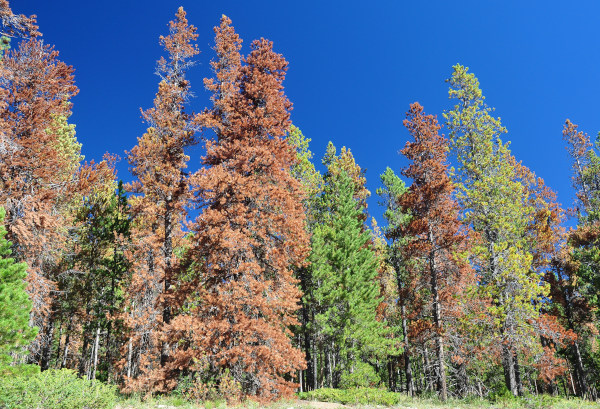
Fading or Discoloring Needles
Healthy green needles that turn yellowish, then rusty red. By the time an entire crown is red, the beetles have typically already exited the tree and moved to new hosts.
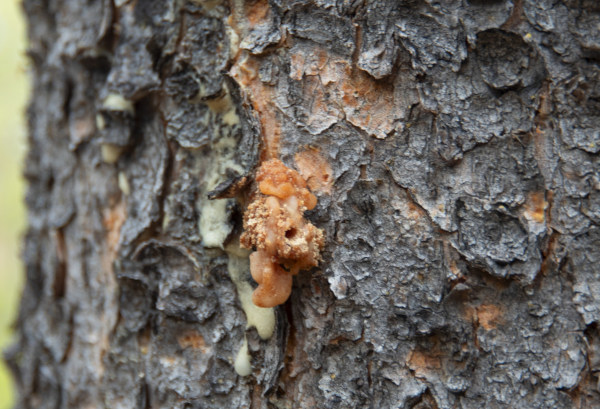
Pitch Tubes on the Trunk
Small, popcorn-shaped masses of resin on the bark surface. These form when the tree tries to "pitch out" boring beetles. Reddish-brown pitch tubes indicate a failed defense.
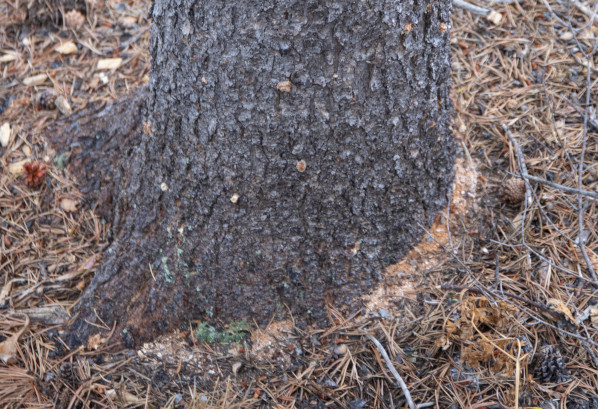
Boring Dust (Frass)
Fine, reddish-brown sawdust accumulating in bark crevices, around the base of the tree, and on spider webs nearby. This indicates active beetle tunneling beneath the bark.
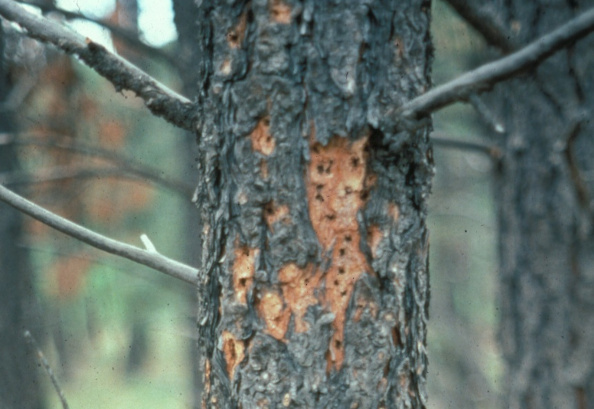
Woodpecker Activity
Heavy woodpecker feeding on trunk and branches strips bark as they search for beetle larvae. Large patches of light-colored, exposed wood are a telltale sign of severe infestation.
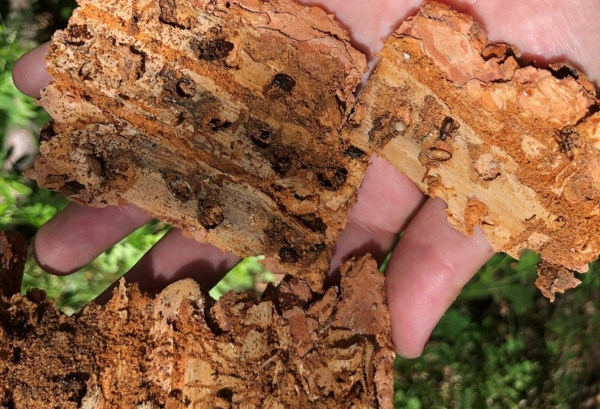
J-Shaped Galleries Under Bark
Peel back a small section of loose bark to reveal tunneling patterns. Mountain pine beetles create distinctive J- or Y-shaped egg galleries carved into the inner bark.
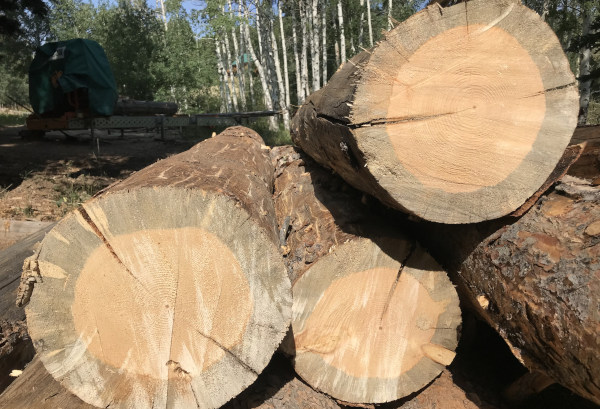
Blue Stain Fungus
Beetles carry blue stain fungus that blocks the tree's water-conducting tissues. Cross-cut sections of affected wood show distinctive blue-gray streaking through the sapwood.
Photos: Colorado State Forest Service
Nearby Front Range Communities
Latest from the Blog
View All →
Colorado's 2026 Pine Beetle Response: Task Force, Funding, and What It Means for Homeowners
Governor Polis created a statewide task force, Jefferson County launched a $500K cost-share program, and the legislature is funding biological controls. Here's what Colorado is actually doing about the pine beetle outbreak — and what homeowners need to know.

Colorado's Ponderosa Mountain Pine Beetle Task Force: What It Is, Who's Behind It, and What It Means for the Front Range
Colorado's Ponderosa Mountain Pine Beetle Task Force was created to fight the expanding Front Range outbreak. Here's what the task force is doing and what it means for you.