
Pine Beetle Prevention in Palmer Lake, Colorado
Protect your trees from bark beetle infestations in Palmer Lake, El Paso County. Local prevention tips, risk assessment, and professional resources.
Elevation
7,237'
Population
2,987
County
El Paso
Primary Trees
Ponderosa Pine
CSFS Mountain Pine Beetle Activity — El Paso County
Documented
Active beetles in county
Adjacent
Nearby activity
Not Documented
No confirmed activity
Source: Colorado State Forest Service aerial surveys, 2024
Mountain Pine Beetle in El Paso County
El Paso County represents the southern extent of the Front Range MPB outbreak, with documented beetle activity in ponderosa pine forests from Black Forest through Monument and into the western foothills near Colorado Springs.
El Paso County Details
The 2013 Black Forest Fire already demonstrated the catastrophic fire risk in El Paso County's pine forests. Now beetle-killed trees are adding to fuel loads in the same communities. Teller County Commissioner Dan Williams, from neighboring Cripple Creek, serves on the state Pine Beetle Task Force.
Key Finding
Southern extent of the Front Range outbreak; compounding fire risk from 2013 Black Forest Fire legacy
Front Range Outbreak Trend
Acres of MPB-caused tree mortality, Front Range. Source: CSFS Aerial Surveys, 2020–2024
700K+
Acres of vulnerable pine along the Front Range
1,767%
Increase in affected acres, 2020–2024
Data sourced from Colorado State Forest Service aerial survey reports, forest health publications, and local reporting.
Pine Beetle Guide for Palmer Lake, Colorado
Palmer Lake is a small mountain community of approximately 2,987 residents in northwestern El Paso County, nestled at 7,237 feet in a narrow valley at the crest of the Palmer Divide. The town takes its name from the natural reservoir lake at its center, one of the few natural lakes along the Front Range, which sits in a glacially carved basin surrounded by steep, densely forested ridges. Palmer Lake's compact downtown, centered along Highway 105, gives way almost immediately to steep hillsides covered in thick Ponderosa Pine forest that climbs toward the Rampart Range and Pike National Forest. The town's mountain character, small-town atmosphere, and accessibility via the Santa Fe Trail have made it a beloved community — and one that faces some of the most intense pine beetle pressure on the Colorado Front Range.
Pine Beetle Risk in Palmer Lake
Palmer Lake holds a Critical pine beetle risk rating, the highest on the scale, earned through a convergence of factors that create near-ideal conditions for beetle proliferation.
At 7,237 feet, Palmer Lake sits above the elevation where mountain pine beetle activity is most aggressive in Ponderosa Pine forests. The town's bowl-shaped topography — a valley floor surrounded by forested ridges rising another 500 to 1,000 feet — creates a natural amphitheater effect that traps warm air during summer days and concentrates beetle flight activity. The surrounding ridges are blanketed in dense, mature Ponderosa Pine stands that have not been thinned by fire in over a century.
Palmer Lake's direct connection to Pike National Forest is even more immediate than most Front Range communities. The town's western boundary is literally the national forest boundary, and properties along Upper Glenway, Shady Lane, and the Ben Lomond area back directly onto federal forest land. There is no buffer. Beetles emerging from national forest trees can reach residential Ponderosas without a sustained flight — in some cases, they simply walk from one tree to the next.
The Palmer Divide ridgeline creates challenging precipitation patterns for Palmer Lake. While the town's elevation generates some orographic lift, its position at the crest of the Divide means it receives precipitation intermittently and unreliably. Extended dry spells are common, and the town's soils — thin, rocky, granitic decomposition over bedrock — hold virtually no moisture reserve. Trees growing on the steep slopes surrounding the lake depend on timely rainfall and snowmelt, making them acutely drought-sensitive.
Palmer Lake experienced significant beetle-related tree mortality during the 2008-2013 outbreak cycle, losing hundreds of Ponderosas on the ridges above town. The scars of that event are still visible — standing dead timber on the slopes above the reservoir and along the ridgeline trail system. Residents who lived through that cycle describe a community-wide transformation as hillsides of green gave way to rust and gray.
Prevention Tips for Palmer Lake Properties
Palmer Lake's extreme beetle pressure, combined with its small geographic area and tight community, makes it uniquely suited for whole-community prevention approaches.
Community-Coordinated Treatment Programs: Palmer Lake's small size — roughly one square mile of residential development — makes it an ideal candidate for town-wide coordinated beetle treatment. Several Palmer Lake neighborhoods have organized collective spraying contracts, bringing a licensed applicator through on a set schedule during the late April to mid-May treatment window and splitting mobilization costs across dozens of homeowners. If your street or neighborhood has not organized a collective program, talk to your neighbors. The per-tree savings from volume purchasing are significant, and the community-wide coverage is far more effective than scattered individual treatment. The Palmer Lake Volunteer Fire Department can help facilitate neighborhood coordination.
Rapid Dead Tree Removal as Population Control: In Palmer Lake's continuous forest, every beetle-killed tree that remains standing through the following summer's emergence season produces 1,000 to 3,000 new beetles. Those beetles need travel only a few feet to reach the next susceptible host. Prompt removal of dead and dying trees is not aesthetics — it is direct beetle population management. Remove dead trees before April of the year following their death to eliminate them before emergence. Palmer Lake's compact geography means that even a dozen unremoved dead trees scattered across the community represent a meaningful beetle source that pressures every remaining living pine.
Aggressive Watering on Rocky Soils: Palmer Lake's thin, granitic soils require more frequent watering than most communities to maintain tree hydration through dry periods. For key Ponderosas near structures, water every two to three weeks during extended dry spells — defined as more than 21 days without significant precipitation — rather than the monthly schedule adequate at lower elevations. Deliver water via soaker hose at the drip line. Palmer Lake's water supply comes from wells and the reservoir, with limited surplus during drought. Check with the town for current guidelines and restrictions. Prioritize the trees that provide the most value — shade over your home, screening from neighbors, windbreak protection — and accept that you cannot water every pine in the forest.
Urgent Thinning for Overcrowded Properties: If your property has not been thinned, this is the single most impactful action you can take. Palmer Lake's forests frequently exceed 200 stems per acre — four to five times the density recommended for beetle-resistant conditions. Thin to 50 to 70 stems per acre around structures, removing the smallest, weakest, and most suppressed trees while retaining the largest, healthiest Ponderosas. On Palmer Lake's steep slopes, hand-crew thinning is often the only practical approach — budget accordingly. Contact the Palmer Lake Volunteer Fire Department or El Paso County Wildfire Mitigation Program for defensible space guidance that incorporates beetle resistance.
Slash Removal Without Exception: In Palmer Lake's continuous forest, leaving pine slash on-site after thinning is counterproductive — you are creating beetle breeding habitat while trying to reduce beetle risk. Remove all slash from the property within two weeks of cutting. If immediate removal is not feasible, stack and tarp tightly with clear plastic during warm months. Burning is permitted during limited fall and winter windows; coordinate with the Palmer Lake fire department for permits and conditions. Do not chip and leave pine material on-site between April and September.
Local Resources
- Palmer Lake Volunteer Fire Department provides defensible space assessments, coordinates community wildfire and beetle mitigation, and can facilitate neighborhood-level treatment program organization. Their staff understand Palmer Lake's specific terrain and forest challenges intimately.
- El Paso County Wildfire Mitigation Program offers property assessments and may provide cost-sharing for thinning and defensible space work in Palmer Lake's wildland-urban interface — which effectively includes the entire community.
- Pike National Forest — Pikes Peak Ranger District manages the federal forest immediately adjacent to Palmer Lake's western boundary. Contact them for current beetle conditions on public land, which directly predict pressure on residential properties.
- Colorado State Forest Service offers technical assistance, beetle species identification from bark samples, and administers cost-sharing programs for forest health treatments on private land.
- Town of Palmer Lake coordinates with county and state agencies on forest health issues, facilitates community communication about beetle threats, and can direct residents to available resources and assistance programs.
- Tri-Lakes area community organizations including the Palmer Lake Historical Society and local trail groups maintain awareness of forest conditions throughout the community and provide informal monitoring networks.
Nearby Affected Areas
Palmer Lake is embedded in a corridor of Critical beetle risk along the southern Palmer Divide. Monument to the south shares the same forest belt and Critical risk rating, with beetle populations moving freely between the two communities. Larkspur to the north sits on the opposite flank of the Divide with equally dense forest and equally high risk. To the west, Pike National Forest provides the vast reservoir of beetle-susceptible trees that supplies pressure to all Palmer Divide communities. Woodland Park, deeper in the mountains at over 8,400 feet, experiences some of the Front Range's most intense mountain pine beetle activity. And Colorado Springs, expanding northward toward Monument, faces increasing beetle risk in its rapidly developing northern neighborhoods that interface with the Palmer Divide pine belt.
Common Pine Beetle Species in Colorado
Three bark beetle species pose the greatest threat to pine trees in Palmer Lake and across Colorado's Front Range.
Mountain Pine Beetle
Dendroctonus ponderosae
The primary killer of Ponderosa and Lodgepole pines along the Front Range. Adults are black, about the size of a grain of rice (5mm). They use aggregation pheromones to coordinate mass attacks that overwhelm a tree's pitch defenses.
- ● Targets trees 8"+ diameter
- ● One generation per year (July–August flight)
- ● Carries blue stain fungus that blocks water transport
- ● Creates J-shaped egg galleries under bark
Ips Engraver Beetle
Ips pini
A smaller, opportunistic beetle that exploits any weakness: drought stress, pruning wounds, fresh slash piles, or construction damage to roots. Less dramatic than MPB but persistent and hard to prevent entirely.
- ● Attacks trees of any size, including limbs
- ● 2–3 generations per year (April–October)
- ● Creates Y-shaped egg galleries under bark
- ● Often the first beetle to attack stressed trees
Red Turpentine Beetle
Dendroctonus valens
The largest bark beetle in North America (up to 10mm). Typically attacks the lower trunk of weakened or injured trees. Rarely kills trees on its own but signals stress that can attract MPB and Ips beetles.
- ● Attacks lower 6 feet of trunk
- ● Produces large, quarter-sized pitch tubes
- ● Indicator species for tree stress
- ● Often found after construction or root damage
Species data: Colorado State Forest Service, USDA Forest Service
Signs of Pine Beetle Infestation
Knowing what to look for is the first step to protecting your Palmer Lake property. Here are the key warning signs every homeowner should monitor.
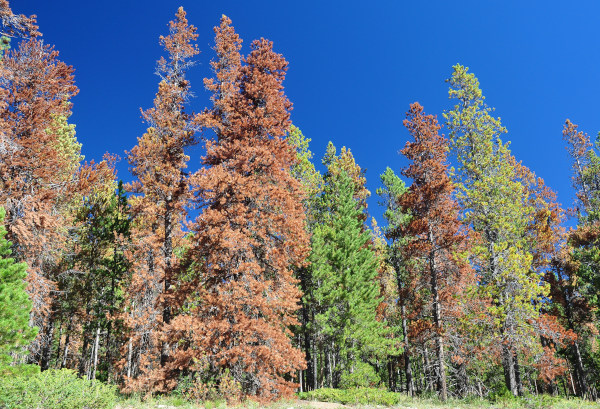
Fading or Discoloring Needles
Healthy green needles that turn yellowish, then rusty red. By the time an entire crown is red, the beetles have typically already exited the tree and moved to new hosts.
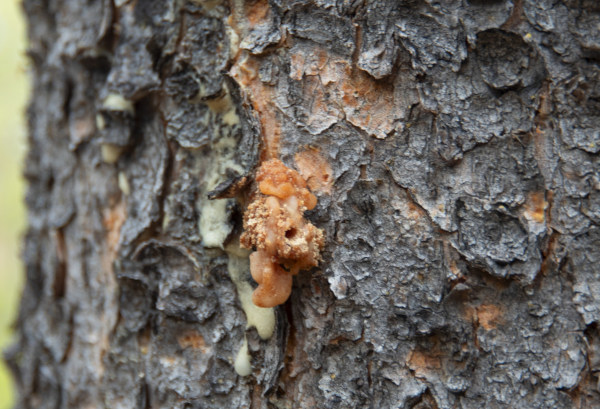
Pitch Tubes on the Trunk
Small, popcorn-shaped masses of resin on the bark surface. These form when the tree tries to "pitch out" boring beetles. Reddish-brown pitch tubes indicate a failed defense.
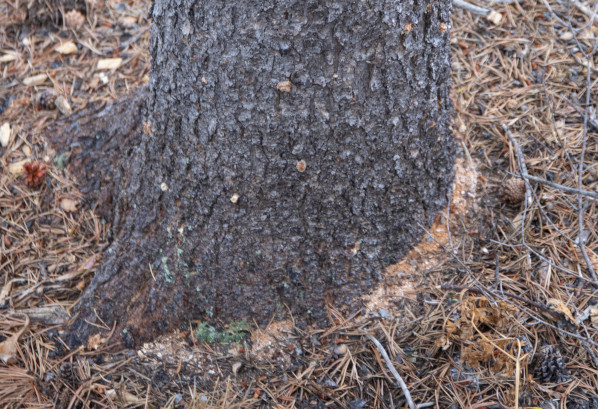
Boring Dust (Frass)
Fine, reddish-brown sawdust accumulating in bark crevices, around the base of the tree, and on spider webs nearby. This indicates active beetle tunneling beneath the bark.
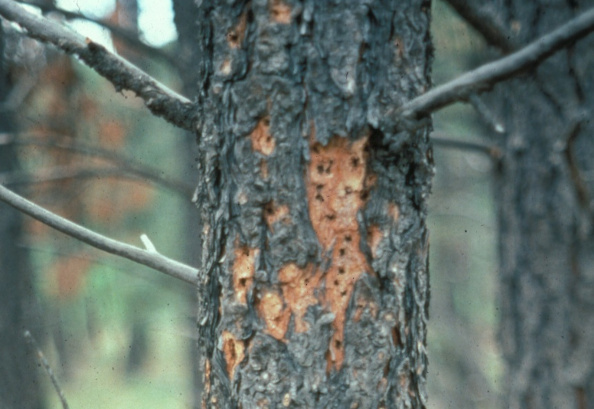
Woodpecker Activity
Heavy woodpecker feeding on trunk and branches strips bark as they search for beetle larvae. Large patches of light-colored, exposed wood are a telltale sign of severe infestation.
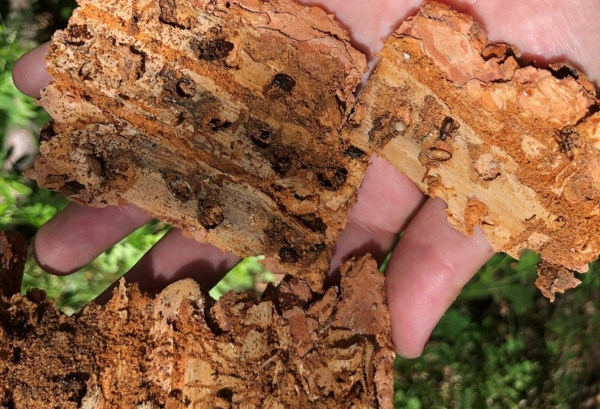
J-Shaped Galleries Under Bark
Peel back a small section of loose bark to reveal tunneling patterns. Mountain pine beetles create distinctive J- or Y-shaped egg galleries carved into the inner bark.
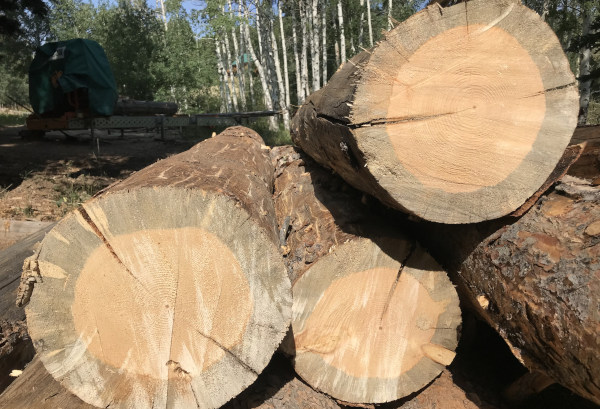
Blue Stain Fungus
Beetles carry blue stain fungus that blocks the tree's water-conducting tissues. Cross-cut sections of affected wood show distinctive blue-gray streaking through the sapwood.
Photos: Colorado State Forest Service
Nearby Front Range Communities
Latest from the Blog
View All →
Colorado's 2026 Pine Beetle Response: Task Force, Funding, and What It Means for Homeowners
Governor Polis created a statewide task force, Jefferson County launched a $500K cost-share program, and the legislature is funding biological controls. Here's what Colorado is actually doing about the pine beetle outbreak — and what homeowners need to know.

Colorado's Ponderosa Mountain Pine Beetle Task Force: What It Is, Who's Behind It, and What It Means for the Front Range
Colorado's Ponderosa Mountain Pine Beetle Task Force was created to fight the expanding Front Range outbreak. Here's what the task force is doing and what it means for you.