
Pine Beetle Prevention in Sedalia, Colorado
Protect your trees from bark beetle infestations in Sedalia, Douglas County. Local prevention tips, risk assessment, and professional resources.
Elevation
6,020'
Population
206
County
Douglas
Primary Trees
Ponderosa Pine
CSFS Mountain Pine Beetle Activity — Douglas County
Documented
Active beetles in county
Adjacent
Nearby activity
Not Documented
No confirmed activity
Source: Colorado State Forest Service aerial surveys, 2024
Mountain Pine Beetle in Douglas County
Douglas County has elevated MPB infestation levels across its ponderosa pine forests, particularly along the Palmer Divide where Castle Rock, Castle Pines, and Larkspur are situated.
Douglas County Details
The Palmer Divide's ponderosa-dominated forests are a prime target for mountain pine beetles. Douglas County's rapid suburban growth has created extensive wildland-urban interface zones where residential properties border unthinned forest stands. The county forestry division provides site assessments and thinning recommendations.
Key Finding
Elevated infestation levels documented across county's Palmer Divide forests
Front Range Outbreak Trend
Acres of MPB-caused tree mortality, Front Range. Source: CSFS Aerial Surveys, 2020–2024
700K+
Acres of vulnerable pine along the Front Range
1,767%
Increase in affected acres, 2020–2024
Data sourced from Colorado State Forest Service aerial survey reports, forest health publications, and local reporting.
Pine Beetle Guide for Sedalia, Colorado
Sedalia is a quiet, unincorporated community of approximately 206 residents in western Douglas County, perched at 6,020 feet along the foothills where the high plains break into the mountains. Located at the junction of Highway 85 and Highway 67, Sedalia serves as the gateway to the Rampart Range and the eastern approaches of Pike National Forest. The community is defined by its large-acreage rural properties, many of them horse ranches and homesteads, set among open meadows framed by thick Ponderosa Pine forests climbing the adjacent ridges. Indian Creek and its tributaries carve through the landscape, creating riparian corridors interspersed with dense pine stands that extend westward into unbroken national forest. Sedalia's sparse population belies the severity of its pine beetle challenge.
Pine Beetle Risk in Sedalia
Sedalia carries a Critical pine beetle risk rating driven by its direct interface with Pike National Forest and the structural characteristics of its surrounding forest.
Unlike more developed Front Range communities where construction has fragmented the forest canopy, Sedalia's landscape retains nearly continuous Ponderosa Pine cover on its western and southern flanks. The Rampart Range rises immediately to the west, and the transition from Sedalia's valley floor to national forest land is seamless — in many cases, private property boundaries run through the middle of dense pine stands that extend for miles into public land. This lack of separation means Sedalia absorbs beetle pressure from an enormous forest area.
The soils around Sedalia are primarily decomposed Pikes Peak granite — coarse, rocky, and shallow. These soils drain rapidly and hold minimal plant-available water, leaving Ponderosa Pines dependent on timely precipitation. Sedalia's position in the rain shadow created by the Rampart Range ridgeline means it misses some of the orographic precipitation that benefits communities farther up the mountains. During drought years, trees on south-facing slopes around Sedalia can enter severe moisture stress by June.
The forest structure in the Sedalia area reflects over a century of fire suppression. Natural Ponderosa Pine stands in this region evolved with low-intensity ground fires every 10 to 25 years that thinned young trees and maintained open, parklike conditions. Without fire, Sedalia's forests have grown into dense, multi-storied thickets where competition for water and light weakens every tree. This overstocking is the single largest factor driving beetle susceptibility in the community.
The 2002 Hayman Fire, the largest in Colorado's recorded history, burned through forests approximately 15 miles southwest of Sedalia. While Sedalia itself was not directly affected, the fire's impact on the regional forest ecosystem was profound — disrupted beetle population dynamics, massive quantities of dead and stressed timber, and altered drainage patterns that have affected water availability across the region for decades.
Prevention Tips for Sedalia Properties
Sedalia's rural setting demands a forest management approach rather than individual tree care. The scale of most Sedalia properties — 10 to 40 acres or more — requires multi-year planning and phased implementation.
Prescribed Fire as a Management Tool: Sedalia's rural character, large lot sizes, and proximity to national forest land make it one of the few Front Range communities where prescribed fire is a practical forest management tool. A well-planned low-intensity prescribed burn can thin understory trees, reduce slash accumulation, consume beetle-breeding material, and release nutrients back into the soil — accomplishing in a few hours what would take weeks of mechanical thinning. The Douglas County Prescribed Burn Council and Pike National Forest both conduct burns in the area and can advise on planning and permitting. If your property is suitable, prescribed fire is the most cost-effective path to beetle-resistant stand conditions. Coordinate with your local fire protection district for guidance on burn windows and safety requirements.
Phased Mechanical Thinning for Large Acreages: On a 20-acre Sedalia property, thinning the entire forest in one season is neither affordable nor practical. Develop a multi-year plan that treats 5 to 10 acres per year, starting with the 100-foot defensible space zone around structures and expanding outward. Target a residual density of 50 to 70 trees per acre, removing suppressed, damaged, and small-diameter trees while keeping the largest, most vigorous Ponderosas. A professional forester can create a management plan that sequences treatment areas based on beetle risk priority and budget constraints.
Slash and Firewood Discipline on Ranch Properties: On Sedalia's large rural lots, the temptation to leave slash piles or stack uncured pine firewood is strong. Resist it. Every slash pile is a potential beetle nursery that sustains local populations year after year. Either chip slash immediately to under three inches, burn during permitted fall and winter windows, or remove material from the property. Firewood should be debarked or tarped with clear plastic from April through September. If you heat with wood, process and split rounds promptly and burn your pine supply by early spring.
Prioritized Water Delivery on Well Systems: Sedalia's well-dependent water supply limits how many trees you can irrigate. Rather than spreading limited water across the whole property, focus on the 10 to 15 highest-value trees closest to your home and barn. Deliver water via soaker hose at the drip line during dry periods — one deep soak per month from October through May builds the moisture reserves that trees convert to defensive pitch during summer beetle flight. During drought years, supplemental summer watering every three to four weeks for these priority trees can make the difference between successful pitch defense and beetle colonization.
Create Thinned Boundary Strips: Where your property borders national forest or dense unmanaged private forest, create a thinned buffer strip at least 200 feet wide along the boundary. This transition zone reduces beetle dispersal velocity from the wildland into your managed stands. It also creates a wildfire fuel break, addresses two of Sedalia's primary risks simultaneously.
Local Resources
- Pike National Forest — South Platte Ranger District manages the federal lands west of Sedalia. Their ranger staff can provide current information on beetle activity levels in the forest surrounding your property and can coordinate management activities on adjacent federal land with your private-land thinning schedule.
- Douglas County Forestry Division provides free property walk-throughs for Sedalia landowners, including forest management planning assistance and thinning prescriptions tailored to your acreage and tree conditions.
- Sedalia Fire Protection District offers defensible space evaluations that integrate beetle-killed tree removal with wildfire preparedness. Their staff understand the unique challenges of protecting rural structures in continuous forest.
- Colorado State Forest Service administers cost-sharing programs for forest health treatments on private land, with grants that can cover up to 50 percent of thinning costs for qualifying properties. For Sedalia's larger acreages, these grants can make the difference between affordable and prohibitive thinning projects.
- Douglas County Conservation District assists landowners with conservation planning that includes forest health components, and can connect you with technical service providers experienced in managing rural forest properties.
Nearby Affected Areas
Sedalia's beetle risk is inseparable from the larger Palmer Divide forest corridor. Immediately to the south, Larkspur faces identical Critical risk conditions with even denser forest cover. Castle Rock to the southeast shares the Palmer Divide pine belt and its associated beetle pressure. To the west, the Rampart Range connects Sedalia's forests to the vast expanse of Pike National Forest, where beetle populations build in outbreak years and disperse toward Front Range communities. To the north, Morrison and the foothills communities of Jefferson County face similar interface challenges where residential areas meet continuous forest.
Common Pine Beetle Species in Colorado
Three bark beetle species pose the greatest threat to pine trees in Sedalia and across Colorado's Front Range.
Mountain Pine Beetle
Dendroctonus ponderosae
The primary killer of Ponderosa and Lodgepole pines along the Front Range. Adults are black, about the size of a grain of rice (5mm). They use aggregation pheromones to coordinate mass attacks that overwhelm a tree's pitch defenses.
- ● Targets trees 8"+ diameter
- ● One generation per year (July–August flight)
- ● Carries blue stain fungus that blocks water transport
- ● Creates J-shaped egg galleries under bark
Ips Engraver Beetle
Ips pini
A smaller, opportunistic beetle that exploits any weakness: drought stress, pruning wounds, fresh slash piles, or construction damage to roots. Less dramatic than MPB but persistent and hard to prevent entirely.
- ● Attacks trees of any size, including limbs
- ● 2–3 generations per year (April–October)
- ● Creates Y-shaped egg galleries under bark
- ● Often the first beetle to attack stressed trees
Red Turpentine Beetle
Dendroctonus valens
The largest bark beetle in North America (up to 10mm). Typically attacks the lower trunk of weakened or injured trees. Rarely kills trees on its own but signals stress that can attract MPB and Ips beetles.
- ● Attacks lower 6 feet of trunk
- ● Produces large, quarter-sized pitch tubes
- ● Indicator species for tree stress
- ● Often found after construction or root damage
Species data: Colorado State Forest Service, USDA Forest Service
Signs of Pine Beetle Infestation
Knowing what to look for is the first step to protecting your Sedalia property. Here are the key warning signs every homeowner should monitor.
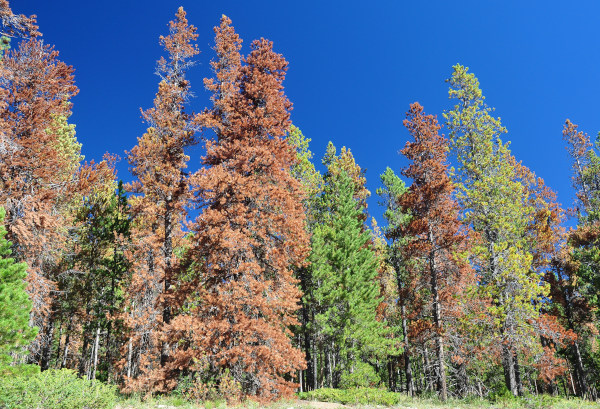
Fading or Discoloring Needles
Healthy green needles that turn yellowish, then rusty red. By the time an entire crown is red, the beetles have typically already exited the tree and moved to new hosts.
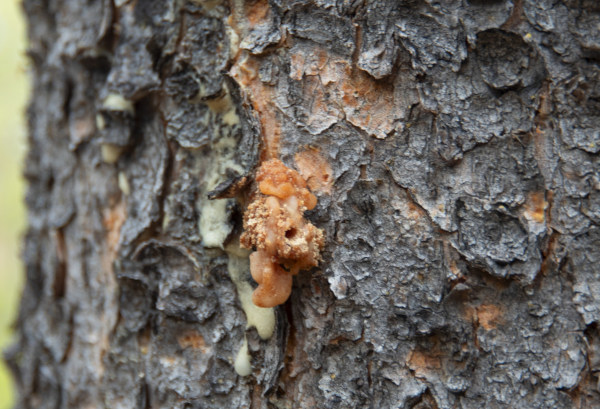
Pitch Tubes on the Trunk
Small, popcorn-shaped masses of resin on the bark surface. These form when the tree tries to "pitch out" boring beetles. Reddish-brown pitch tubes indicate a failed defense.
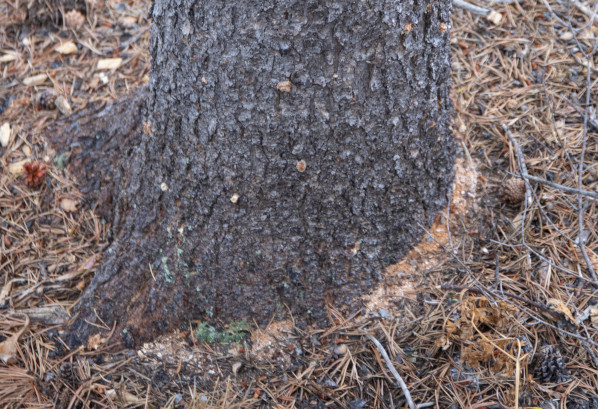
Boring Dust (Frass)
Fine, reddish-brown sawdust accumulating in bark crevices, around the base of the tree, and on spider webs nearby. This indicates active beetle tunneling beneath the bark.
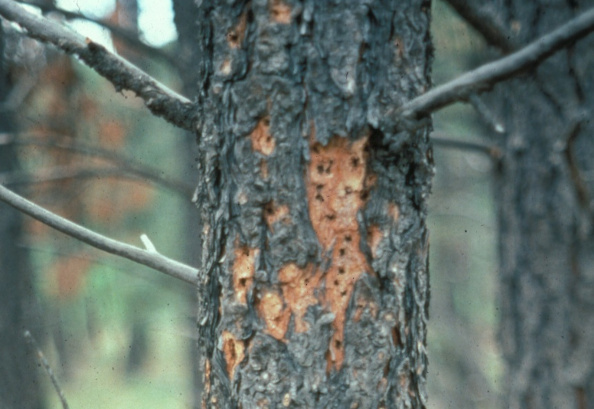
Woodpecker Activity
Heavy woodpecker feeding on trunk and branches strips bark as they search for beetle larvae. Large patches of light-colored, exposed wood are a telltale sign of severe infestation.
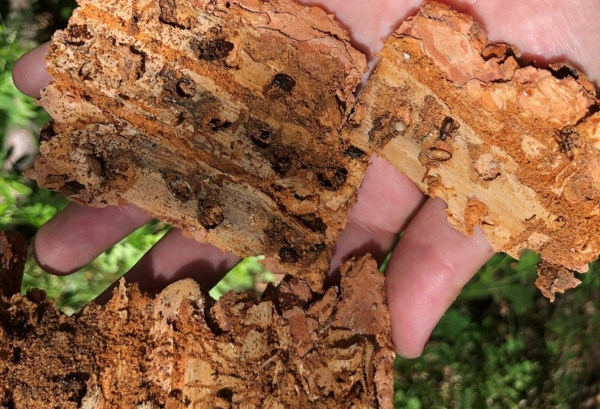
J-Shaped Galleries Under Bark
Peel back a small section of loose bark to reveal tunneling patterns. Mountain pine beetles create distinctive J- or Y-shaped egg galleries carved into the inner bark.
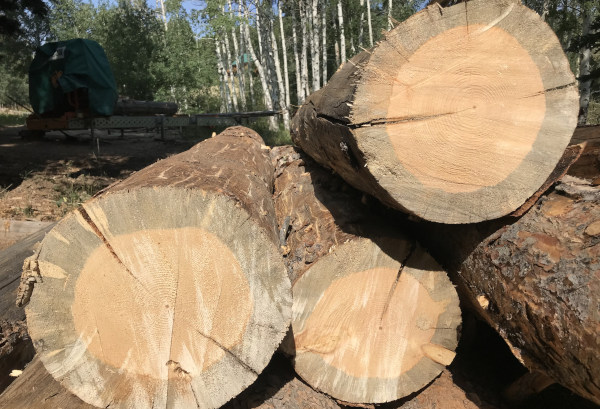
Blue Stain Fungus
Beetles carry blue stain fungus that blocks the tree's water-conducting tissues. Cross-cut sections of affected wood show distinctive blue-gray streaking through the sapwood.
Photos: Colorado State Forest Service
Nearby Front Range Communities
Castle Pines
Douglas County
Beetle Activity Documented
Castle Rock
Douglas County
Beetle Activity Documented
Highlands Ranch
Douglas County
Beetle Activity Documented
Larkspur
Douglas County
Beetle Activity Documented
Lone Tree
Douglas County
Beetle Activity Documented
Parker
Douglas County
Beetle Activity Documented
Latest from the Blog
View All →
Colorado's 2026 Pine Beetle Response: Task Force, Funding, and What It Means for Homeowners
Governor Polis created a statewide task force, Jefferson County launched a $500K cost-share program, and the legislature is funding biological controls. Here's what Colorado is actually doing about the pine beetle outbreak — and what homeowners need to know.

Colorado's Ponderosa Mountain Pine Beetle Task Force: What It Is, Who's Behind It, and What It Means for the Front Range
Colorado's Ponderosa Mountain Pine Beetle Task Force was created to fight the expanding Front Range outbreak. Here's what the task force is doing and what it means for you.