
Pine Beetle Prevention in Estes Park, Colorado
Protect your trees from bark beetle infestations in Estes Park, Larimer County. Local prevention tips, risk assessment, and professional resources.
Elevation
7,522'
Population
6,100
County
Larimer
Primary Trees
Ponderosa Pine, Lodgepole Pine
CSFS Mountain Pine Beetle Activity — Larimer County
Documented
Active beetles in county
Adjacent
Nearby activity
Not Documented
No confirmed activity
Source: Colorado State Forest Service aerial surveys, 2024
Mountain Pine Beetle in Larimer County
Southern Larimer County foothills are experiencing elevated MPB infestation levels, with activity intensifying in forested areas west of Fort Collins and Loveland.
Larimer County Details
Larimer County Commissioner Shadduck-McNally has been appointed to the state's Ponderosa Mountain Pine Beetle Task Force. The county's foothills forests, particularly in the southern portions, are seeing expanding beetle populations.
Key Finding
Larimer County foothills identified as active MPB zone in 2024 CSFS aerial surveys
Front Range Outbreak Trend
Acres of MPB-caused tree mortality, Front Range. Source: CSFS Aerial Surveys, 2020–2024
700K+
Acres of vulnerable pine along the Front Range
1,767%
Increase in affected acres, 2020–2024
Data sourced from Colorado State Forest Service aerial survey reports, forest health publications, and local reporting.
Pine Beetle Guide for Estes Park, Colorado
Estes Park is a mountain town of approximately 6,100 year-round residents in Larimer County, cradled in a broad valley at 7,522 feet where the Big Thompson River emerges from the eastern slopes of the Continental Divide. Serving as the primary gateway to Rocky Mountain National Park, Estes Park draws over four million visitors annually who come for the stunning mountain scenery, abundant wildlife, and recreational opportunities. The town itself is surrounded on three sides by national park and national forest land, creating an island of residential and commercial development within a vast, continuous forest of Ponderosa Pine, Lodgepole Pine, Douglas Fir, and Engelmann Spruce. This forest encirclement, combined with the mixed pine species at elevation, makes Estes Park one of the most beetle-vulnerable communities in Colorado.
Pine Beetle Risk in Estes Park
Estes Park holds a Critical pine beetle risk designation, fully warranted by the community's extraordinary exposure to bark beetle outbreaks in its surrounding public forests.
At 7,522 feet, Estes Park sits in the heart of the mountain pine beetle's optimal elevation range. The town occupies a large valley — the Estes Valley — that opens to the east but is enclosed by forested mountains on the north, west, and south. This horseshoe of forest, almost entirely within Rocky Mountain National Park and Roosevelt National Forest, represents one of the largest concentrations of beetle-susceptible pine on the northern Front Range.
Rocky Mountain National Park experienced one of the most severe mountain pine beetle epidemics in its recorded history during 2006-2013. The park's Lodgepole Pine forests on the east side were devastated, with mortality rates exceeding 90 percent in some stands. The Ponderosa Pine populations at lower elevations — including the slopes immediately above Estes Park — suffered significant losses as well. The park's no-harvest policy meant that beetle populations built to enormous levels in standing dead timber before the epidemic collapsed naturally, and the beetle pressure on adjacent private land in Estes Park was intense throughout.
The town's encirclement by public land means Estes Park cannot create buffer zones against beetle dispersal. Federal forest and parkland border the community on every side except the eastern entrance corridor along Highway 36 and Highway 34. Private properties in neighborhoods like Eagle Rock, Devils Gulch, Fall River Estates, and Windcliff sit directly against park or forest boundaries, with no transition between managed and unmanaged forest.
The Estes Valley's microclimate is influenced by its mountain setting. Temperature inversions can trap warm air in the valley during calm conditions, creating local microclimates warmer than the elevation would suggest. This warmth can accelerate beetle development and extend the effective flight season. The valley's wind patterns — downslope breezes in the evening, upslope flows during the day — distribute beetles efficiently across the community.
The 2020 East Troublesome Fire, which burned into the western boundary of Rocky Mountain National Park, and the Cameron Peak Fire the same year, the largest in Colorado history, altered massive areas of forest north and west of Estes Park. The post-fire landscape of stressed surviving trees and regenerating forest will influence beetle dynamics in the Estes Park area for decades.
Prevention Tips for Estes Park Properties
Estes Park's beetle prevention must contend with the unique reality that the surrounding federal land — Rocky Mountain National Park — is managed for ecological preservation rather than beetle suppression, creating a permanent beetle source that private landowners cannot influence.
Elk Damage Prevention for Young Trees: Protect valued young Ponderosa Pines (under 10 inches diameter) from elk antler rubbing by installing wire mesh cylinders around the lower 6 feet of trunk from September through December each year. Elk rubs are purely a cosmetic concern for the elk but create beetle entry points that can transform a healthy young tree into a beetle target. The mesh should stand several inches off the bark to prevent elk from pressing against the trunk through the wire. This is a low-cost, high-impact intervention unique to Estes Park's elk-rich environment.
Comprehensive Thinning with Terrain Constraints: Thin Ponderosa Pine to 50 to 60 trees per acre and Lodgepole Pine to 60 to 80 trees per acre around structures. In Estes Park's complex terrain, hand-crew thinning is often the only option on steep slopes and in areas with limited road access. Prioritize the 200-foot zone around structures — this extended defensible space zone reflects the intensity of Estes Park's beetle and wildfire risk. The Estes Valley Fire Protection District has been a nationally recognized leader in community thinning programs; their guidance is invaluable for planning your project.
Community Slash Coordination as Standard Practice: In Estes Park's small-lot mountain development, slash disposal is a community-scale problem that requires community-scale solutions. The Estes Valley Fire Protection District operates an annual slash collection program and maintains a community slash site. Schedule your thinning to align with collection windows. Never leave slash on-site during warm months in Estes Park's extreme beetle environment — the risk of slash colonization is not theoretical; it is virtually guaranteed.
Frequent Watering on Thin Mountain Soils: Estes Park's rocky mountain soils drain rapidly, and the growing season's intense sun exposure accelerates evapotranspiration. For valued Ponderosas near structures, water every two to three weeks during extended dry periods — more frequently than the monthly schedule adequate at lower elevations. The Town of Estes Park's water supply comes from the glacier-fed Big Thompson River; check with the town for current watering restrictions during drought. Focus supplemental water on the trees you cannot afford to lose — those that shade your home, screen your view, or define your lot's mountain character.
Engage with Federal Land Management: Estes Park's beetle management is uniquely intertwined with federal land management decisions. Participate in Rocky Mountain National Park and Roosevelt National Forest public comment periods for forest management plans. Support the Estes Park Wildfire Partners program, which coordinates between private landowners and federal agencies on landscape-scale forest health. Understanding what the federal agencies plan to do — and what they explicitly will not do — on the lands surrounding your property is essential context for your own management decisions.
Local Resources
- Estes Valley Fire Protection District provides defensible space assessments, coordinates community thinning and slash collection, and has received national recognition for wildfire mitigation programming. Their staff understand Estes Park's beetle-elk-fire nexus as well as anyone in the state. Start with them.
- Rocky Mountain National Park resource management division monitors beetle conditions within the park and publishes periodic reports on forest health. Their data provides essential context for understanding the beetle pressure arriving from park lands.
- Roosevelt National Forest — Canyon Lakes Ranger District manages federal land east and north of Estes Park with active beetle monitoring programs.
- Estes Park Wildfire Partners coordinates community-wide wildfire and forest health preparedness, bridging between private landowners, fire districts, and federal agencies.
- Town of Estes Park Forestry Program manages town-owned trees and coordinates with county and state agencies on community forest health.
- Larimer County Natural Resources provides property-level natural resource planning for homeowners in the greater Estes Park area.
- Colorado State Forest Service — Larimer County provides technical assistance, beetle species identification, and cost-sharing programs for private landowners.
Nearby Affected Areas
Estes Park's beetle dynamics are dominated by its relationship with surrounding public forests. Rocky Mountain National Park to the west and south has experienced catastrophic mountain pine beetle and spruce beetle mortality. To the south, Lyons and Boulder face High risk as receiving communities for beetles dispersing out of the St. Vrain canyons. Loveland and Fort Collins to the east face Moderate risk along the Big Thompson and Cache la Poudre corridors. The mountain communities west of Estes Park — Grand Lake, Granby — experienced devastating mountain pine beetle epidemics that altered the landscape on a scale visible from space. Estes Park sits at the eastern terminus of this mountain beetle corridor, receiving pressure from one of the most severely beetle-impacted forest landscapes in North America.
Common Pine Beetle Species in Colorado
Three bark beetle species pose the greatest threat to pine trees in Estes Park and across Colorado's Front Range.
Mountain Pine Beetle
Dendroctonus ponderosae
The primary killer of Ponderosa and Lodgepole pines along the Front Range. Adults are black, about the size of a grain of rice (5mm). They use aggregation pheromones to coordinate mass attacks that overwhelm a tree's pitch defenses.
- ● Targets trees 8"+ diameter
- ● One generation per year (July–August flight)
- ● Carries blue stain fungus that blocks water transport
- ● Creates J-shaped egg galleries under bark
Ips Engraver Beetle
Ips pini
A smaller, opportunistic beetle that exploits any weakness: drought stress, pruning wounds, fresh slash piles, or construction damage to roots. Less dramatic than MPB but persistent and hard to prevent entirely.
- ● Attacks trees of any size, including limbs
- ● 2–3 generations per year (April–October)
- ● Creates Y-shaped egg galleries under bark
- ● Often the first beetle to attack stressed trees
Red Turpentine Beetle
Dendroctonus valens
The largest bark beetle in North America (up to 10mm). Typically attacks the lower trunk of weakened or injured trees. Rarely kills trees on its own but signals stress that can attract MPB and Ips beetles.
- ● Attacks lower 6 feet of trunk
- ● Produces large, quarter-sized pitch tubes
- ● Indicator species for tree stress
- ● Often found after construction or root damage
Species data: Colorado State Forest Service, USDA Forest Service
Signs of Pine Beetle Infestation
Knowing what to look for is the first step to protecting your Estes Park property. Here are the key warning signs every homeowner should monitor.
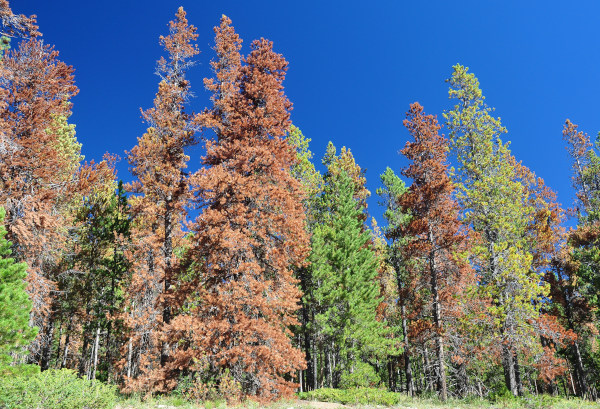
Fading or Discoloring Needles
Healthy green needles that turn yellowish, then rusty red. By the time an entire crown is red, the beetles have typically already exited the tree and moved to new hosts.
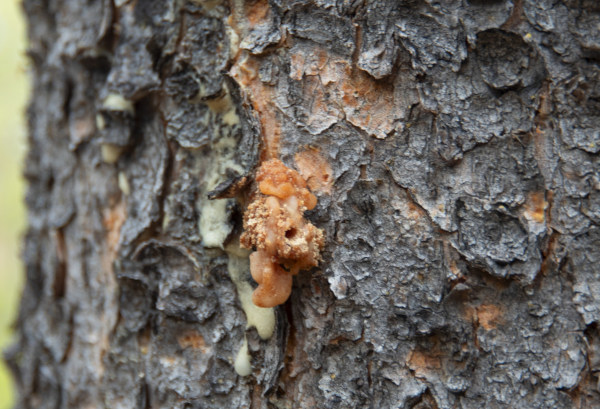
Pitch Tubes on the Trunk
Small, popcorn-shaped masses of resin on the bark surface. These form when the tree tries to "pitch out" boring beetles. Reddish-brown pitch tubes indicate a failed defense.
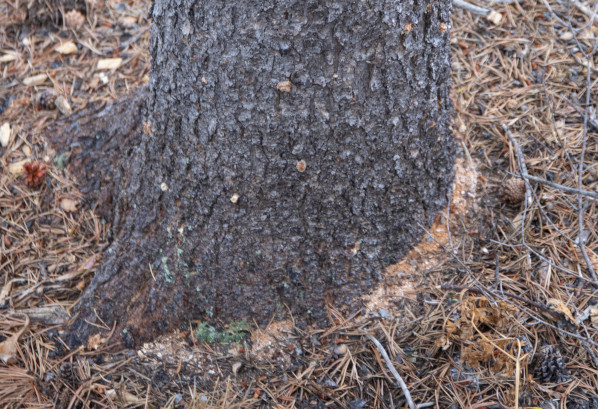
Boring Dust (Frass)
Fine, reddish-brown sawdust accumulating in bark crevices, around the base of the tree, and on spider webs nearby. This indicates active beetle tunneling beneath the bark.
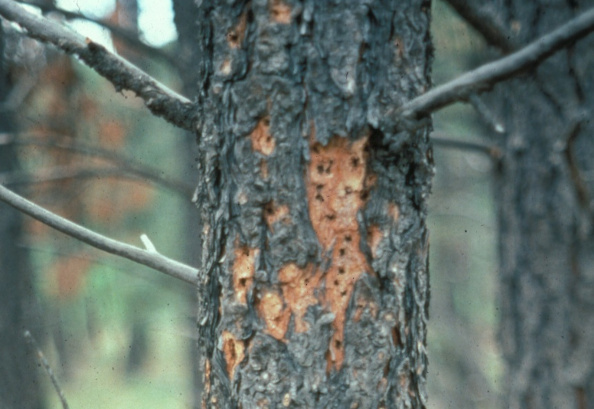
Woodpecker Activity
Heavy woodpecker feeding on trunk and branches strips bark as they search for beetle larvae. Large patches of light-colored, exposed wood are a telltale sign of severe infestation.
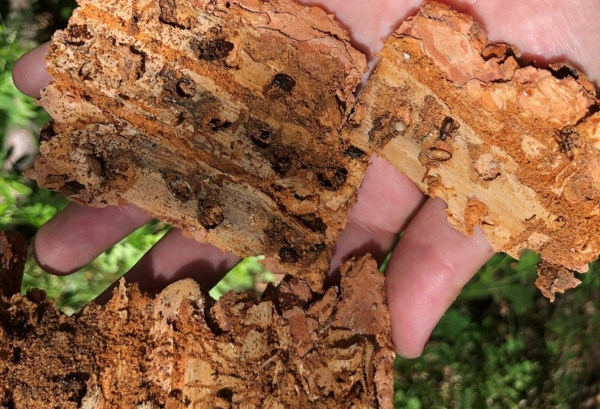
J-Shaped Galleries Under Bark
Peel back a small section of loose bark to reveal tunneling patterns. Mountain pine beetles create distinctive J- or Y-shaped egg galleries carved into the inner bark.
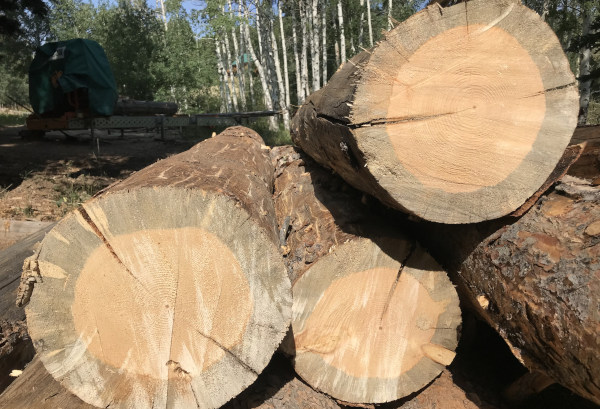
Blue Stain Fungus
Beetles carry blue stain fungus that blocks the tree's water-conducting tissues. Cross-cut sections of affected wood show distinctive blue-gray streaking through the sapwood.
Photos: Colorado State Forest Service
Nearby Front Range Communities
Latest from the Blog
View All →
Colorado's 2026 Pine Beetle Response: Task Force, Funding, and What It Means for Homeowners
Governor Polis created a statewide task force, Jefferson County launched a $500K cost-share program, and the legislature is funding biological controls. Here's what Colorado is actually doing about the pine beetle outbreak — and what homeowners need to know.

Colorado's Ponderosa Mountain Pine Beetle Task Force: What It Is, Who's Behind It, and What It Means for the Front Range
Colorado's Ponderosa Mountain Pine Beetle Task Force was created to fight the expanding Front Range outbreak. Here's what the task force is doing and what it means for you.