
Pine Beetle Prevention in Fort Collins, Colorado
Protect your trees from bark beetle infestations in Fort Collins, Larimer County. Local prevention tips, risk assessment, and professional resources.
Elevation
5,003'
Population
174,800
County
Larimer
Primary Trees
Ponderosa Pine
CSFS Mountain Pine Beetle Activity — Larimer County
Documented
Active beetles in county
Adjacent
Nearby activity
Not Documented
No confirmed activity
Source: Colorado State Forest Service aerial surveys, 2024
Mountain Pine Beetle in Larimer County
Southern Larimer County foothills are experiencing elevated MPB infestation levels, with activity intensifying in forested areas west of Fort Collins and Loveland.
Larimer County Details
Larimer County Commissioner Shadduck-McNally has been appointed to the state's Ponderosa Mountain Pine Beetle Task Force. The county's foothills forests, particularly in the southern portions, are seeing expanding beetle populations.
Key Finding
Larimer County foothills identified as active MPB zone in 2024 CSFS aerial surveys
Front Range Outbreak Trend
Acres of MPB-caused tree mortality, Front Range. Source: CSFS Aerial Surveys, 2020–2024
700K+
Acres of vulnerable pine along the Front Range
1,767%
Increase in affected acres, 2020–2024
Data sourced from Colorado State Forest Service aerial survey reports, forest health publications, and local reporting.
Pine Beetle Guide for Fort Collins, Colorado
Fort Collins is a city of approximately 174,800 residents in Larimer County, situated at 5,003 feet where the Cache la Poudre River emerges from its mountain canyon onto the northern Colorado plains. Home to Colorado State University — the state's land-grant institution and a center of forestry and entomology research — Fort Collins is one of the largest and most educated communities on the Front Range. The city stretches from open agricultural land on the east to the Poudre River canyon and Horsetooth Reservoir on the west, where the foothills rise sharply into Roosevelt National Forest. Ponderosa Pine is a prominent feature of the western foothills landscape, the Horsetooth Rock area, and numerous residential neighborhoods where native pines were preserved or planted during development. Fort Collins' Moderate risk rating reflects its lower elevation and urban character, but the city's proximity to severely beetle-affected mountain forests demands ongoing vigilance.
Pine Beetle Risk in Fort Collins
Fort Collins is rated Moderate for pine beetle risk, a classification that accounts for the city's lower elevation and dispersed pine population while recognizing meaningful threats in specific areas.
At 5,003 feet — the lowest elevation among the 25 communities assessed — Fort Collins sits below the range where mountain pine beetles sustain reliable populations. However, the city's beetle risk is not uniformly low. The western neighborhoods — Overland Trail area, the Ridge, West Fort Collins near Horsetooth Reservoir, and properties along the Poudre River canyon — feature Ponderosa Pine on foothill terrain and face risk approaching the High threshold. The central and eastern portions of the city have scattered landscape pines at lower risk.
The Cache la Poudre River canyon, which opens directly into Fort Collins' northwestern neighborhoods, serves as a major beetle dispersal pathway from the mountain forests to the west. The upper Poudre watershed — including the Pingree Park area, Crown Point, and the forests surrounding Chambers Lake — experienced severe mountain pine beetle mortality during the 2006-2013 epidemic. Beetles dispersing down the canyon reach Fort Collins' western neighborhoods during summer flight seasons.
The 2012 High Park Fire burned 87,000 acres of Ponderosa Pine forest in the hills directly west and southwest of Fort Collins, destroying 259 homes and dramatically altering the forest landscape. The beetle-fire connection was evident — many of the burned forests contained beetle-killed trees that contributed to fire intensity. The post-fire landscape of stressed surviving trees and regenerating forest continues to influence beetle dynamics on Fort Collins' western perimeter.
The Cameron Peak Fire of 2020 — the largest wildfire in Colorado history at 208,913 acres — burned through vast areas of mountain forest northwest of Fort Collins. While the fire's perimeter was primarily above 7,000 feet, its aftermath has altered watershed health, beetle habitat, and forest stress patterns across the region.
Fort Collins' soils in the western foothills are rocky and well-drained, while the central and eastern portions feature deeper agricultural soils — clay loam and alluvial deposits. Ponderosa Pines on the rocky western soils face drought stress similar to mountain communities, while those on deeper eastern soils generally have better moisture access.
Colorado State University's Department of Forest and Rangeland Stewardship and the Colorado State Forest Service (headquartered on the CSU campus) provide Fort Collins with unparalleled local expertise in bark beetle ecology and management.
Prevention Tips for Fort Collins Properties
Fort Collins' prevention benefits from two unique advantages: the lowest elevation of any assessed community (providing natural protection) and the presence of CSU and the state forest service headquarters (providing unmatched expertise).
Leverage Local Expertise: No other Front Range community has the density of bark beetle expertise that Fort Collins does. The Colorado State Forest Service, headquartered on the CSU campus, offers free consultations, beetle identification services, and access to the latest research findings. CSU's Department of Forest and Rangeland Stewardship occasionally offers community workshops and field days. Take advantage of these resources — they are literally down the street. If you are unsure whether your tree's decline is beetle-related or caused by some other factor, bring a bark sample or photos to the CSFS office for definitive identification.
Foothills Properties — Fire-Beetle Integrated Management: Properties near the western foothills should implement defensible space standards that simultaneously address beetle and fire risk. The Poudre Fire Authority provides free wildfire mitigation assessments that include beetle management recommendations. Thin Ponderosa stands to 50 to 70 trees per acre around structures. The dual benefit of fire and beetle prevention makes this investment doubly valuable in Fort Collins' fire-prone western neighborhoods.
Extended-Season Urban Tree Care: Fort Collins' long, warm growing season means Ponderosa Pines face stress over a longer period than in mountain communities. Supplemental watering should span March through October on the rocky western soils — monthly applications via soaker hose at the drip line. On the deeper eastern soils, water every six weeks from April through September at slower delivery rates. Critically, a single deep watering in January or February during dry winters can provide more beetle prevention benefit per gallon than any summer watering — winter drought stress determines whether a tree has pitch reserves for the following summer's beetle defense.
March Pruning Deadline: In Fort Collins' warm microclimate, Ips beetles activate as early as late March in warm years. All Ponderosa Pine pruning should be completed by March 15 — not the end of March, not "early spring," but mid-March at the latest. This earlier deadline reflects Fort Collins' position as the warmest city in the assessment. The City Forestry Division enforces this timing for city-managed trees and recommends the same standard for private property.
Citizen Science Contribution: Fort Collins' connection to Colorado State University creates robust community science infrastructure. Report beetle sightings, dead trees, and declining pines through the Colorado State Forest Service's online reporting system. Your observations feed into the state-level monitoring network that tracks beetle population trends across the Front Range. Fort Collins residents' reports are particularly valuable because they document beetle behavior at the lowest elevation in the monitoring area.
Local Resources
- Colorado State Forest Service (CSFS) is headquartered on the CSU campus in Fort Collins — the state's primary resource for bark beetle information, technical assistance, identification services, and cost-sharing programs. Their staff are national leaders in bark beetle research. This is the single most valuable resource available to any Fort Collins resident with beetle concerns.
- Poudre Fire Authority provides wildfire mitigation assessments integrating beetle management for Fort Collins properties, particularly in the western wildland-urban interface.
- City of Fort Collins Forestry Division manages city-owned trees, coordinates the urban forest health program, and enforces pruning timing standards.
- CSU Department of Forest and Rangeland Stewardship conducts bark beetle research and occasionally offers community education programs and field days.
- Roosevelt National Forest — Canyon Lakes Ranger District manages federal land west of Fort Collins and monitors beetle conditions in the Poudre Canyon corridor.
- Larimer County Natural Resources provides property-level natural resource planning for properties in unincorporated areas near Fort Collins.
- Coalition for the Poudre River Watershed coordinates watershed health initiatives including post-fire forest recovery in the Poudre corridor.
Nearby Affected Areas
Fort Collins' beetle risk is influenced by its position at the base of the Poudre Canyon corridor. Estes Park to the southwest faces Critical risk in its mountain setting surrounded by Rocky Mountain National Park. Loveland to the south shares Fort Collins' Moderate risk profile and similar foothills interface. Lyons and Boulder to the south face High risk at the base of the St. Vrain and Boulder Creek canyons. The mountain forests of the upper Poudre, Pingree Park, and the Cameron Peak Fire area continue to generate beetle dispersal pressure toward Fort Collins. The city's relatively low elevation provides some natural protection, but the warming climate trend is gradually eroding that buffer.
Common Pine Beetle Species in Colorado
Three bark beetle species pose the greatest threat to pine trees in Fort Collins and across Colorado's Front Range.
Mountain Pine Beetle
Dendroctonus ponderosae
The primary killer of Ponderosa and Lodgepole pines along the Front Range. Adults are black, about the size of a grain of rice (5mm). They use aggregation pheromones to coordinate mass attacks that overwhelm a tree's pitch defenses.
- ● Targets trees 8"+ diameter
- ● One generation per year (July–August flight)
- ● Carries blue stain fungus that blocks water transport
- ● Creates J-shaped egg galleries under bark
Ips Engraver Beetle
Ips pini
A smaller, opportunistic beetle that exploits any weakness: drought stress, pruning wounds, fresh slash piles, or construction damage to roots. Less dramatic than MPB but persistent and hard to prevent entirely.
- ● Attacks trees of any size, including limbs
- ● 2–3 generations per year (April–October)
- ● Creates Y-shaped egg galleries under bark
- ● Often the first beetle to attack stressed trees
Red Turpentine Beetle
Dendroctonus valens
The largest bark beetle in North America (up to 10mm). Typically attacks the lower trunk of weakened or injured trees. Rarely kills trees on its own but signals stress that can attract MPB and Ips beetles.
- ● Attacks lower 6 feet of trunk
- ● Produces large, quarter-sized pitch tubes
- ● Indicator species for tree stress
- ● Often found after construction or root damage
Species data: Colorado State Forest Service, USDA Forest Service
Signs of Pine Beetle Infestation
Knowing what to look for is the first step to protecting your Fort Collins property. Here are the key warning signs every homeowner should monitor.
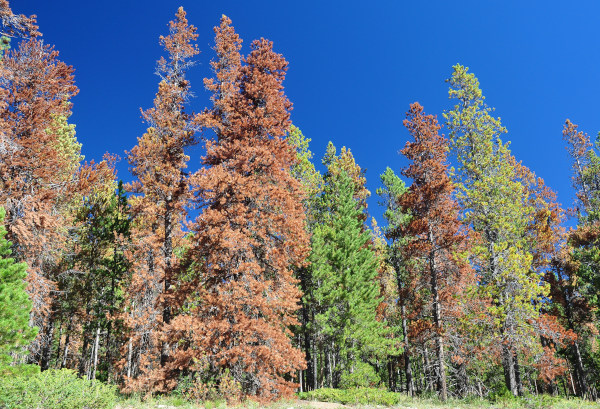
Fading or Discoloring Needles
Healthy green needles that turn yellowish, then rusty red. By the time an entire crown is red, the beetles have typically already exited the tree and moved to new hosts.
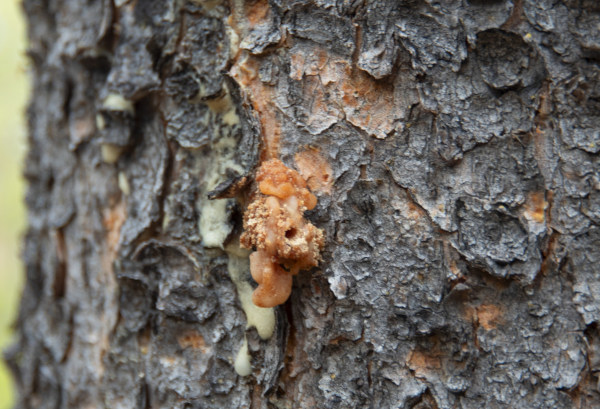
Pitch Tubes on the Trunk
Small, popcorn-shaped masses of resin on the bark surface. These form when the tree tries to "pitch out" boring beetles. Reddish-brown pitch tubes indicate a failed defense.
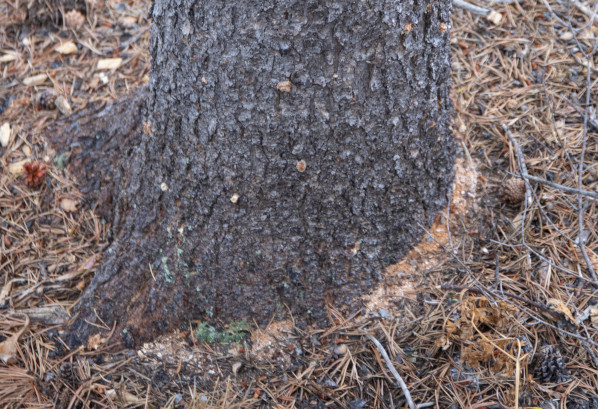
Boring Dust (Frass)
Fine, reddish-brown sawdust accumulating in bark crevices, around the base of the tree, and on spider webs nearby. This indicates active beetle tunneling beneath the bark.
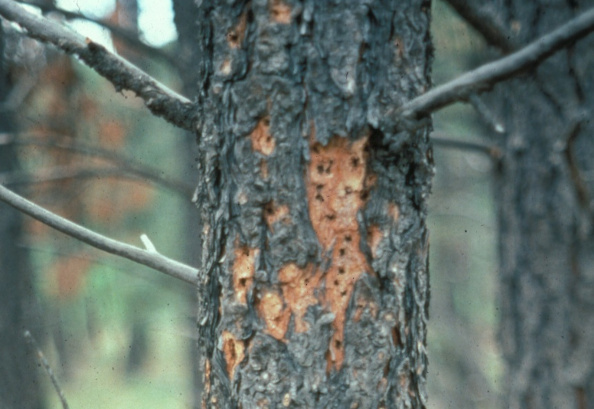
Woodpecker Activity
Heavy woodpecker feeding on trunk and branches strips bark as they search for beetle larvae. Large patches of light-colored, exposed wood are a telltale sign of severe infestation.
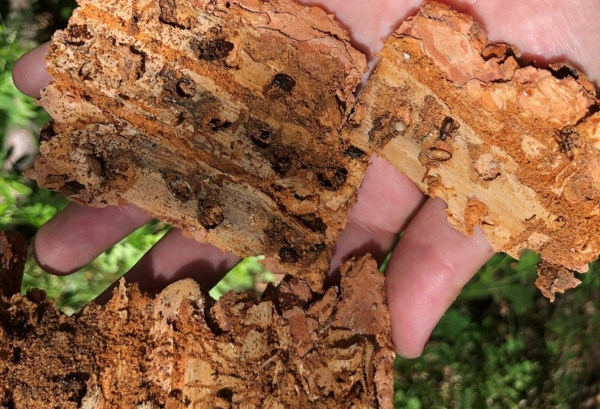
J-Shaped Galleries Under Bark
Peel back a small section of loose bark to reveal tunneling patterns. Mountain pine beetles create distinctive J- or Y-shaped egg galleries carved into the inner bark.
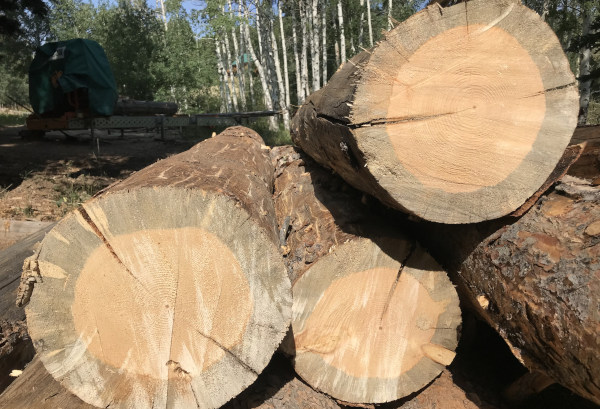
Blue Stain Fungus
Beetles carry blue stain fungus that blocks the tree's water-conducting tissues. Cross-cut sections of affected wood show distinctive blue-gray streaking through the sapwood.
Photos: Colorado State Forest Service
Nearby Front Range Communities
Latest from the Blog
View All →
Colorado's 2026 Pine Beetle Response: Task Force, Funding, and What It Means for Homeowners
Governor Polis created a statewide task force, Jefferson County launched a $500K cost-share program, and the legislature is funding biological controls. Here's what Colorado is actually doing about the pine beetle outbreak — and what homeowners need to know.

Colorado's Ponderosa Mountain Pine Beetle Task Force: What It Is, Who's Behind It, and What It Means for the Front Range
Colorado's Ponderosa Mountain Pine Beetle Task Force was created to fight the expanding Front Range outbreak. Here's what the task force is doing and what it means for you.