
Pine Beetle Prevention in Lyons, Colorado
Protect your trees from bark beetle infestations in Lyons, Boulder County. Local prevention tips, risk assessment, and professional resources.
Elevation
5,374'
Population
2,200
County
Boulder
Primary Trees
Ponderosa Pine
CSFS Mountain Pine Beetle Activity — Boulder County
Documented
Active beetles in county
Adjacent
Nearby activity
Not Documented
No confirmed activity
Source: Colorado State Forest Service aerial surveys, 2024
Mountain Pine Beetle in Boulder County
Boulder County is experiencing an intensifying MPB outbreak, particularly in Upper Lefthand Canyon and the Jamestown area, with foothills forests expected to look markedly different by late 2026.
Boulder County Details
The Boulder Reporting Lab documented the outbreak's rapid expansion in February 2026. Community concern is heightened following the Marshall Fire experience, as beetle-killed trees add to fuel loads in WUI areas. State Representative Lesley Smith (Boulder) serves on the Pine Beetle Task Force.
Key Finding
Upper Lefthand Canyon and Jamestown area identified as rapidly intensifying outbreak zones
Front Range Outbreak Trend
Acres of MPB-caused tree mortality, Front Range. Source: CSFS Aerial Surveys, 2020–2024
700K+
Acres of vulnerable pine along the Front Range
1,767%
Increase in affected acres, 2020–2024
Data sourced from Colorado State Forest Service aerial survey reports, forest health publications, and local reporting.
Pine Beetle Guide for Lyons, Colorado
Lyons is a small town of approximately 2,200 residents in northern Boulder County, perched at 5,374 feet at the confluence of the North and South St. Vrain Creeks where the foothills canyons open onto the northern Colorado plains. Known as the "Double Gateway to the Rockies," Lyons serves as the primary access point for both Rocky Mountain National Park via Highway 36 and the Peak to Peak Highway via Highway 7. The town's landscape is defined by its dramatic red sandstone formations, cottonwood-lined creek corridors, and the Ponderosa Pine-clad foothills that rise immediately to the west and south. The devastating September 2013 flood, which tore through the St. Vrain corridor and caused enormous damage to the town's infrastructure, remains a defining event in the community's recent history and has lasting implications for the health of Lyons' tree populations.
Pine Beetle Risk in Lyons
Lyons carries a High pine beetle risk rating, reflecting a combination of factors that make this small community more vulnerable than its modest elevation might suggest.
At 5,374 feet, Lyons sits at the lower end of consistent Ponderosa Pine habitat along the Front Range. However, the town's position at the mouth of two major foothill canyons — North St. Vrain Canyon leading to Rocky Mountain National Park and South St. Vrain Canyon leading toward Ward and the Peak to Peak corridor — exposes it to beetle dispersal from heavily infested mountain forests. The canyons act as natural funnels, channeling beetles downslope from forests that have experienced catastrophic mountain pine beetle epidemics over the past two decades.
The forests immediately west and south of Lyons — climbing from 5,400 feet to over 8,000 feet within a few miles — contain dense Ponderosa Pine stands on south-facing slopes and mixed Ponderosa-Lodgepole forests at higher elevations. These forests have been hit hard by mountain pine beetle since the mid-2000s, with extensive mortality visible along both St. Vrain canyon corridors. Beetles from these mountain forests arrive in Lyons with each summer's flight season.
The 2013 flood catastrophically altered the landscape along both St. Vrain Creeks through Lyons. Floodwaters scoured creek banks, undermined tree root systems, deposited debris against trunks, and saturated soils for extended periods. Ponderosa Pines that survived the flood often sustained root damage that has manifested as chronic decline over the following years — reduced growth, thinning crowns, and increased susceptibility to beetle attack. This flood legacy continues to shape Lyons' beetle risk a decade later.
Lyons' red sandstone soils — derived from the Lyons Sandstone formation — are sandy, well-drained, and low in organic matter. While they support healthy Ponderosa Pine under normal moisture conditions, they provide minimal water storage during drought. The alluvial soils along the creek corridors are more variable, ranging from sandy gravel to silty deposits from the 2013 flood.
Prevention Tips for Lyons Properties
Lyons' prevention strategy must address the compound stressors of flood legacy, canyon-mouth beetle pressure, and fast-draining sandstone soils — a combination no other Front Range community faces.
Post-Flood Tree Triage: If you have not had flood-affected Ponderosas professionally assessed since 2013, schedule an arborist visit now. A certified arborist familiar with flood-damage symptoms can identify trees that appear outwardly stable but have fatally compromised root systems — trees on an irreversible decline trajectory that will become beetle sources regardless of care. Removing these doomed trees proactively, before they attract beetles, prevents them from becoming an ongoing pest reservoir for their healthy neighbors. The cost of assessment is small relative to the cost of losing multiple additional trees to beetle spread.
Supplemental Watering for Flood-Stressed Trees: Trees with flood-damaged root systems have reduced water uptake capacity, meaning they need more frequent supplemental watering than undamaged trees to maintain the same level of hydration. For valued flood-zone Ponderosas, water every two to three weeks during drought rather than the monthly schedule adequate for healthy trees. Deliver water via soaker hose at the drip line. Lyons' sandstone soils drain quickly, so ensure each watering session is long enough — three to four hours at a slow trickle — to penetrate to the 12-to-18-inch root zone. Check with the Town of Lyons water system for current usage guidelines before establishing your watering schedule.
Sandstone Soil Organic Matter Amendment: Lyons' thin, sandy sandstone-derived soils are naturally low in organic matter, which limits their water-holding capacity. Around valued Ponderosas, build up a mulch bed — three to four inches of organic mulch from six inches off the trunk to the drip line — that slowly decomposes and improves soil moisture retention over time. This is particularly beneficial near rock features where thermal stress is highest. Annual topping of the mulch bed maintains the benefit as material decomposes.
Canyon-Side Interface Thinning: Properties on the west and south sides of Lyons that interface directly with the foothill forest should implement mountain-community prevention measures. Thin Ponderosa stands to 50 to 70 trees per acre around structures, creating defensible space that simultaneously reduces beetle habitat and wildfire fuel. The Lyons Fire Protection District can provide defensible space assessments tailored to the community's canyon-mouth conditions.
Strict Warm-Season Slash Protocol: Given Lyons' history of flood-reconstruction slash generating beetle problems, the community has hard-won experience with the consequences of leaving pine material on-site. All pine pruning waste, construction debris, and thinning slash should be removed from the property within 48 hours during warm months. No exceptions. Coordinate timing with any community chipping events organized through the town or fire district.
Local Resources
- Town of Lyons Public Works coordinates community infrastructure and can advise on tree-related concerns on town property, including trees in public rights-of-way and along creek corridors.
- Boulder County Parks and Open Space manages open space near Lyons, including Hall Ranch and Heil Valley Ranch, and conducts forest health monitoring on county lands adjacent to town.
- Lyons Fire Protection District provides defensible space assessments for properties in the wildland-urban interface on the west and south sides of town, with recommendations that integrate beetle management.
- Colorado State Forest Service — Boulder District provides technical assistance, beetle identification, and cost-sharing programs for Boulder County property owners.
- Roosevelt National Forest manages federal land west of Lyons and monitors beetle conditions in the upper St. Vrain corridors that supply beetle pressure to Lyons.
- St. Vrain Creek Coalition coordinates watershed health initiatives in the St. Vrain corridor, including post-flood forest and riparian recovery programs relevant to Lyons' ongoing flood-legacy challenges.
Nearby Affected Areas
Lyons' beetle risk is shaped by its connections to both mountain and plains communities. Estes Park to the west, at over 7,500 feet, faces Critical risk in its dense mountain forests — beetles from the Estes Park area and Rocky Mountain National Park disperse down the St. Vrain corridor toward Lyons. Boulder to the south carries High risk in its mountain park system and foothill neighborhoods. Loveland and Fort Collins to the north face Moderate risk as larger urban communities with foothill interfaces. The Peak to Peak Highway corridor west of Lyons — including Allenspark, Ward, and Jamestown — has experienced catastrophic beetle mortality in both Ponderosa and Lodgepole Pine, creating large source populations that affect all downstream communities including Lyons.
Common Pine Beetle Species in Colorado
Three bark beetle species pose the greatest threat to pine trees in Lyons and across Colorado's Front Range.
Mountain Pine Beetle
Dendroctonus ponderosae
The primary killer of Ponderosa and Lodgepole pines along the Front Range. Adults are black, about the size of a grain of rice (5mm). They use aggregation pheromones to coordinate mass attacks that overwhelm a tree's pitch defenses.
- ● Targets trees 8"+ diameter
- ● One generation per year (July–August flight)
- ● Carries blue stain fungus that blocks water transport
- ● Creates J-shaped egg galleries under bark
Ips Engraver Beetle
Ips pini
A smaller, opportunistic beetle that exploits any weakness: drought stress, pruning wounds, fresh slash piles, or construction damage to roots. Less dramatic than MPB but persistent and hard to prevent entirely.
- ● Attacks trees of any size, including limbs
- ● 2–3 generations per year (April–October)
- ● Creates Y-shaped egg galleries under bark
- ● Often the first beetle to attack stressed trees
Red Turpentine Beetle
Dendroctonus valens
The largest bark beetle in North America (up to 10mm). Typically attacks the lower trunk of weakened or injured trees. Rarely kills trees on its own but signals stress that can attract MPB and Ips beetles.
- ● Attacks lower 6 feet of trunk
- ● Produces large, quarter-sized pitch tubes
- ● Indicator species for tree stress
- ● Often found after construction or root damage
Species data: Colorado State Forest Service, USDA Forest Service
Signs of Pine Beetle Infestation
Knowing what to look for is the first step to protecting your Lyons property. Here are the key warning signs every homeowner should monitor.
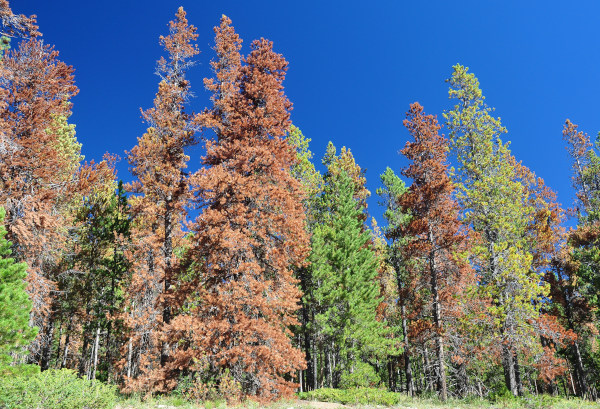
Fading or Discoloring Needles
Healthy green needles that turn yellowish, then rusty red. By the time an entire crown is red, the beetles have typically already exited the tree and moved to new hosts.
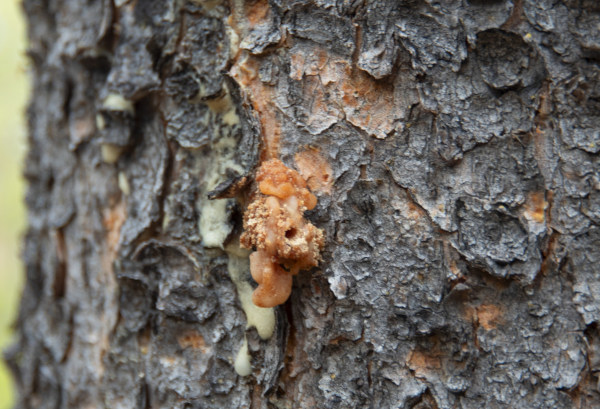
Pitch Tubes on the Trunk
Small, popcorn-shaped masses of resin on the bark surface. These form when the tree tries to "pitch out" boring beetles. Reddish-brown pitch tubes indicate a failed defense.
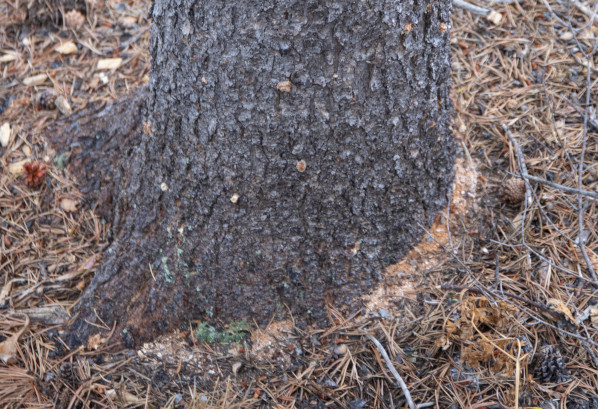
Boring Dust (Frass)
Fine, reddish-brown sawdust accumulating in bark crevices, around the base of the tree, and on spider webs nearby. This indicates active beetle tunneling beneath the bark.
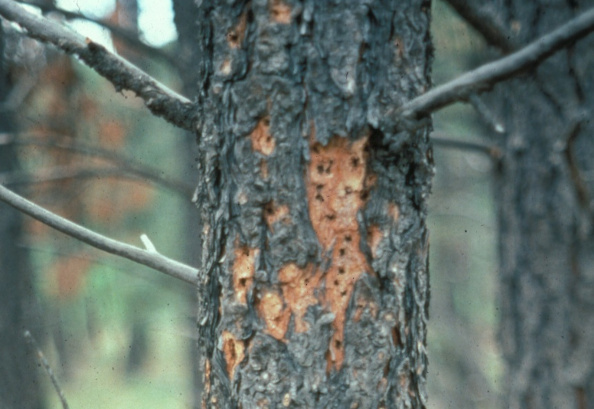
Woodpecker Activity
Heavy woodpecker feeding on trunk and branches strips bark as they search for beetle larvae. Large patches of light-colored, exposed wood are a telltale sign of severe infestation.
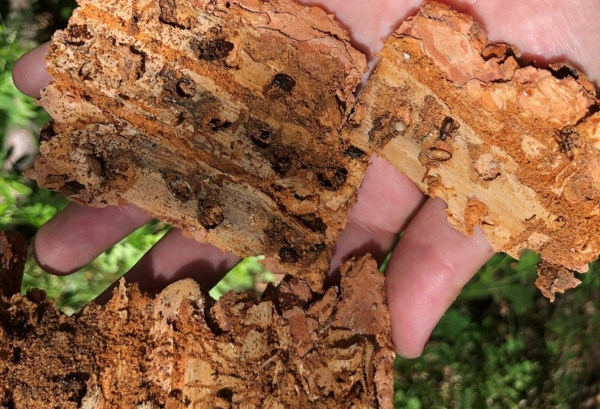
J-Shaped Galleries Under Bark
Peel back a small section of loose bark to reveal tunneling patterns. Mountain pine beetles create distinctive J- or Y-shaped egg galleries carved into the inner bark.
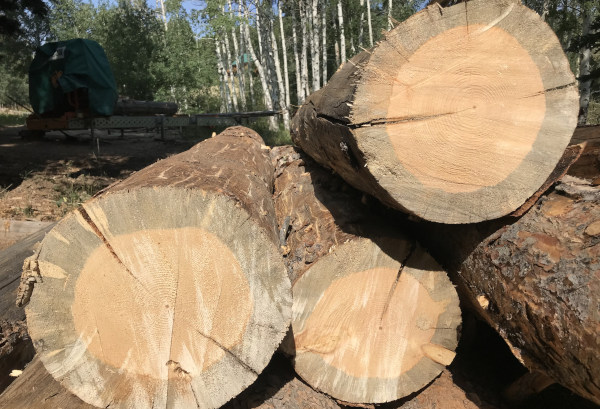
Blue Stain Fungus
Beetles carry blue stain fungus that blocks the tree's water-conducting tissues. Cross-cut sections of affected wood show distinctive blue-gray streaking through the sapwood.
Photos: Colorado State Forest Service
Nearby Front Range Communities
Latest from the Blog
View All →
Colorado's 2026 Pine Beetle Response: Task Force, Funding, and What It Means for Homeowners
Governor Polis created a statewide task force, Jefferson County launched a $500K cost-share program, and the legislature is funding biological controls. Here's what Colorado is actually doing about the pine beetle outbreak — and what homeowners need to know.

Colorado's Ponderosa Mountain Pine Beetle Task Force: What It Is, Who's Behind It, and What It Means for the Front Range
Colorado's Ponderosa Mountain Pine Beetle Task Force was created to fight the expanding Front Range outbreak. Here's what the task force is doing and what it means for you.