
Pine Beetle Prevention in Loveland, Colorado
Protect your trees from bark beetle infestations in Loveland, Larimer County. Local prevention tips, risk assessment, and professional resources.
Elevation
4,982'
Population
81,774
County
Larimer
Primary Trees
Ponderosa Pine
CSFS Mountain Pine Beetle Activity — Larimer County
Documented
Active beetles in county
Adjacent
Nearby activity
Not Documented
No confirmed activity
Source: Colorado State Forest Service aerial surveys, 2024
Mountain Pine Beetle in Larimer County
Southern Larimer County foothills are experiencing elevated MPB infestation levels, with activity intensifying in forested areas west of Fort Collins and Loveland.
Larimer County Details
Larimer County Commissioner Shadduck-McNally has been appointed to the state's Ponderosa Mountain Pine Beetle Task Force. The county's foothills forests, particularly in the southern portions, are seeing expanding beetle populations.
Key Finding
Larimer County foothills identified as active MPB zone in 2024 CSFS aerial surveys
Front Range Outbreak Trend
Acres of MPB-caused tree mortality, Front Range. Source: CSFS Aerial Surveys, 2020–2024
700K+
Acres of vulnerable pine along the Front Range
1,767%
Increase in affected acres, 2020–2024
Data sourced from Colorado State Forest Service aerial survey reports, forest health publications, and local reporting.
Pine Beetle Guide for Loveland, Colorado
Loveland is a city of approximately 81,774 residents in Larimer County, positioned at 4,982 feet where the Big Thompson River flows from its dramatic canyon onto the northern Colorado plains. Known for its thriving arts community, annual Valentine's remailing program, and proximity to both Rocky Mountain National Park and the Big Thompson Canyon, Loveland serves as a residential and commercial hub for the northern Front Range. The city's western edge rises into the foothills along the Big Thompson Canyon, Devil's Backbone, and the ridges surrounding Carter Lake and Flatiron Reservoir, where Ponderosa Pine forms a prominent component of the foothill landscape. While Loveland's lower elevation and largely urban character produce a Moderate overall risk rating, the western foothills neighborhoods face meaningful beetle pressure with ties to the mountain forests above.
Pine Beetle Risk in Loveland
Loveland carries a Moderate pine beetle risk rating, the second lowest assessment among the 25 Front Range communities evaluated. This rating reflects Loveland's position as a plains city with a foothills fringe rather than a mountain community.
At 4,982 feet — the lowest elevation of any community in this assessment — Loveland sits well below the optimal range for mountain pine beetle activity. The city's core, spread across the Big Thompson floodplain and adjacent terraces, has scattered landscape Ponderosa Pines but nothing approaching forest conditions. Beetle risk in Loveland's central and eastern neighborhoods is low.
The western story is different. Loveland's foothills — the area around Devil's Backbone Open Space, the slopes above Carter Lake, the Masonville area, and the Big Thompson Canyon entrance — feature mature Ponderosa Pine stands on rocky, south-facing slopes. These trees face the same drought stress, soil limitations, and beetle pressure that affect other foothills communities, and the risk in this specific geography is higher than the city-wide Moderate rating suggests.
The Big Thompson Canyon is historically significant for both natural disasters and beetle activity. The catastrophic 1976 Big Thompson Flood killed 144 people in the canyon, and the corridor has experienced periodic flash flooding since. The September 2013 flood further damaged canyon infrastructure and stressed forest vegetation. Between flood events, the canyon's Ponderosa Pine forests have experienced periodic mountain pine beetle outbreaks, with beetles dispersing down-canyon into Loveland's western neighborhoods.
The 2000 Bobcat Fire burned 10,599 acres in the foothills directly west of Loveland, including significant Ponderosa Pine habitat. Regrowth forests from that fire are now reaching beetle-susceptible age and size, creating a new cohort of vulnerable trees near the city.
Loveland's soils follow the typical Front Range gradient — rocky, thin, decomposed granite in the western foothills, transitioning to deep clay and loam on the plains. Ponderosa Pines on the foothills soils face regular drought stress, while those planted in deeper eastern soils have better moisture access but may struggle with clay compaction.
Prevention Tips for Loveland Properties
Loveland's prevention approach benefits from its low elevation — the natural environment is not extreme — but must account for the long, warm growing season that gives Ips beetles maximum reproductive opportunity.
Year-Round Watering Program: Loveland's semi-arid climate and extended growing season mean Ponderosa Pines face moisture stress over more months of the year than trees in higher, cooler communities. Supplement natural precipitation with deep watering from March through October on the rocky western soils, and April through September on the deeper eastern soils. Use a soaker hose at the drip line, running slowly for four to six hours per session. Add one or two winter watering sessions during dry December through February periods. The City of Loveland Water and Power Department's drought response plan includes provisions for tree watering — familiarize yourself with current guidelines.
Foothills Property Thinning: Properties near Devil's Backbone, Carter Lake, and the Big Thompson Canyon should thin Ponderosa Pine stands to 50 to 70 trees per acre around structures. The Loveland Fire Rescue Authority provides wildfire mitigation assessments that include beetle management recommendations for western properties. Create 100-foot defensible space zones around structures — the combined beetle and fire prevention value makes this investment one of the most cost-effective property improvements available.
Soil Health for Urban Pines: For landscape Ponderosas in developed areas, soil health is the primary defense against beetle colonization. Maintain mulch beds three to four inches deep from trunk to drip line. Remove turf grass from within the drip line. Avoid compaction from vehicles, foot traffic, and storage. These soil improvements are particularly important for trees planted during Loveland's growth decades — many were installed in fill soil or compacted subgrade that has compromised their root development from day one.
Early-Season Pruning Deadline: At Loveland's low elevation and warm latitude, Ips beetles activate earlier in spring than in any other assessed community. Complete all Ponderosa Pine pruning by March 1 — two weeks earlier than the standard mid-March deadline. This earlier cutoff accounts for Loveland's capacity for warm late-February and early-March weather that activates overwintering beetles. Remove all pruning waste from the property within 24 hours if any emergency cutting is needed during warm months.
Report Dead Trees Promptly: Dead Ponderosas in Loveland's urban setting are primarily beetle production facilities rather than wildfire hazards. Each dead pine standing through a warm season produces beetles that attack neighbors. Report dead trees on city property to the Loveland Parks Division for assessment. On your own property, remove dead or irreversibly declining trees within one season of the decision point.
Local Resources
- Loveland Fire Rescue Authority provides wildfire mitigation assessments for western Loveland properties, integrating beetle management with defensible space planning in the foothills neighborhoods.
- City of Loveland Parks Division manages city-owned trees, coordinates the urban forestry program, and responds to reports of dead or declining trees on public property.
- Larimer County Natural Resources provides property-level resource planning for properties in unincorporated areas near Loveland, including the Masonville and Big Thompson Canyon areas.
- Colorado State Forest Service (headquartered nearby in Fort Collins) is easily accessible to Loveland residents and provides free technical assistance, beetle identification services, and cost-sharing programs. Their proximity makes them a first-call resource.
- Roosevelt National Forest — Canyon Lakes Ranger District manages federal land west of Loveland and monitors beetle conditions in the Big Thompson Canyon corridor.
- Big Thompson Watershed Coalition coordinates watershed health initiatives including post-flood forest recovery in the Big Thompson drainage.
- Devil's Backbone Open Space (Larimer County) monitors tree health on the open space adjacent to western Loveland and can provide condition information relevant to nearby properties.
Nearby Affected Areas
Loveland's beetle risk is shaped by its position at the base of the Big Thompson corridor. Estes Park to the west, at 7,522 feet, faces Critical risk surrounded by Rocky Mountain National Park — beetles from the Estes Park area and the upper Big Thompson Canyon disperse down-canyon toward Loveland. Fort Collins to the north shares Loveland's Moderate risk profile and similar foothills interface. Lyons to the south faces High risk at the mouth of the St. Vrain canyons. Boulder to the south carries High risk in its mountain park system. The mountain forests along the Peak to Peak Highway and in Rocky Mountain National Park continue to influence beetle pressure on all northern Front Range communities, including Loveland.
Common Pine Beetle Species in Colorado
Three bark beetle species pose the greatest threat to pine trees in Loveland and across Colorado's Front Range.
Mountain Pine Beetle
Dendroctonus ponderosae
The primary killer of Ponderosa and Lodgepole pines along the Front Range. Adults are black, about the size of a grain of rice (5mm). They use aggregation pheromones to coordinate mass attacks that overwhelm a tree's pitch defenses.
- ● Targets trees 8"+ diameter
- ● One generation per year (July–August flight)
- ● Carries blue stain fungus that blocks water transport
- ● Creates J-shaped egg galleries under bark
Ips Engraver Beetle
Ips pini
A smaller, opportunistic beetle that exploits any weakness: drought stress, pruning wounds, fresh slash piles, or construction damage to roots. Less dramatic than MPB but persistent and hard to prevent entirely.
- ● Attacks trees of any size, including limbs
- ● 2–3 generations per year (April–October)
- ● Creates Y-shaped egg galleries under bark
- ● Often the first beetle to attack stressed trees
Red Turpentine Beetle
Dendroctonus valens
The largest bark beetle in North America (up to 10mm). Typically attacks the lower trunk of weakened or injured trees. Rarely kills trees on its own but signals stress that can attract MPB and Ips beetles.
- ● Attacks lower 6 feet of trunk
- ● Produces large, quarter-sized pitch tubes
- ● Indicator species for tree stress
- ● Often found after construction or root damage
Species data: Colorado State Forest Service, USDA Forest Service
Signs of Pine Beetle Infestation
Knowing what to look for is the first step to protecting your Loveland property. Here are the key warning signs every homeowner should monitor.
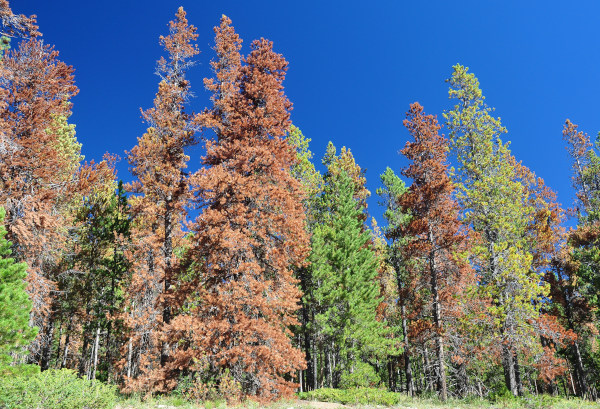
Fading or Discoloring Needles
Healthy green needles that turn yellowish, then rusty red. By the time an entire crown is red, the beetles have typically already exited the tree and moved to new hosts.
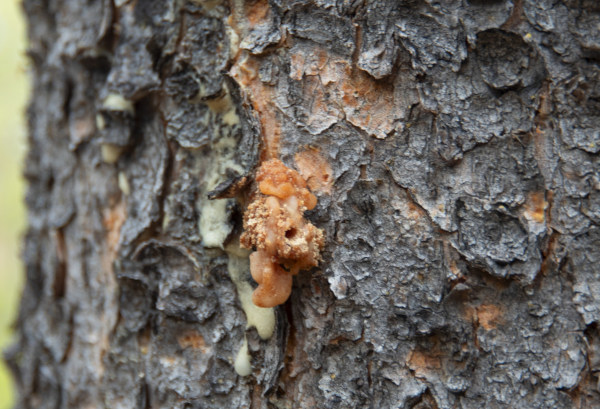
Pitch Tubes on the Trunk
Small, popcorn-shaped masses of resin on the bark surface. These form when the tree tries to "pitch out" boring beetles. Reddish-brown pitch tubes indicate a failed defense.
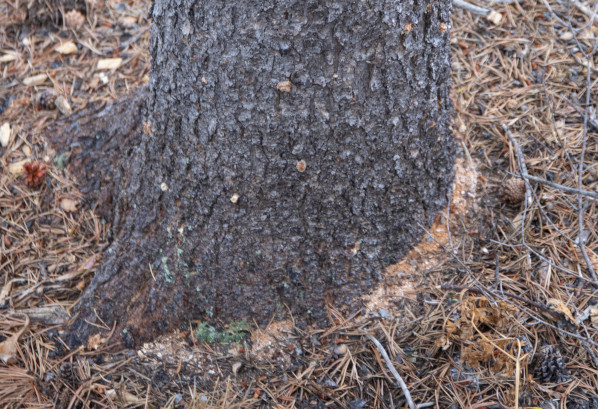
Boring Dust (Frass)
Fine, reddish-brown sawdust accumulating in bark crevices, around the base of the tree, and on spider webs nearby. This indicates active beetle tunneling beneath the bark.
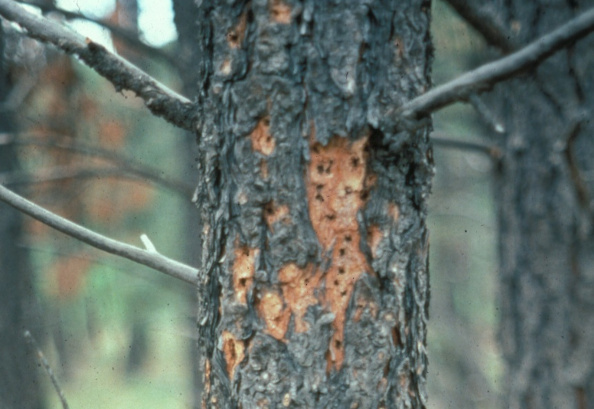
Woodpecker Activity
Heavy woodpecker feeding on trunk and branches strips bark as they search for beetle larvae. Large patches of light-colored, exposed wood are a telltale sign of severe infestation.
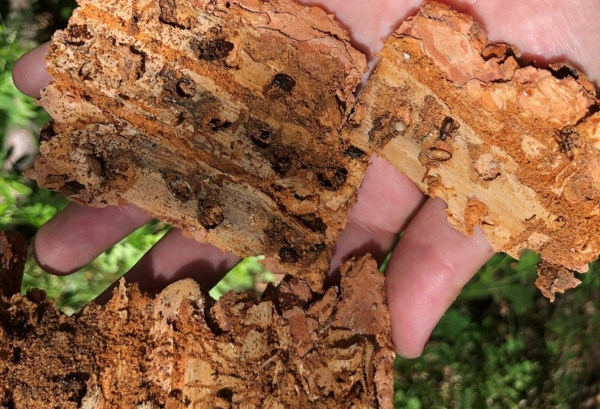
J-Shaped Galleries Under Bark
Peel back a small section of loose bark to reveal tunneling patterns. Mountain pine beetles create distinctive J- or Y-shaped egg galleries carved into the inner bark.
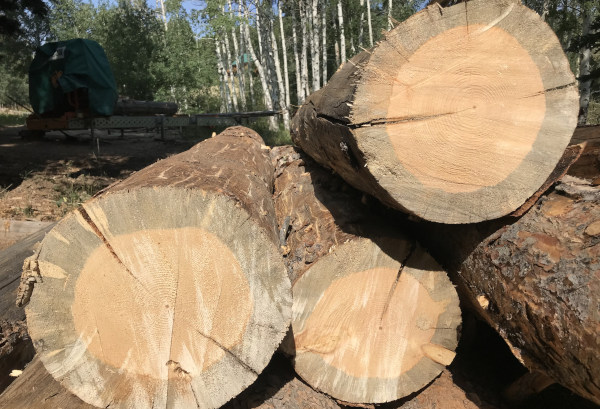
Blue Stain Fungus
Beetles carry blue stain fungus that blocks the tree's water-conducting tissues. Cross-cut sections of affected wood show distinctive blue-gray streaking through the sapwood.
Photos: Colorado State Forest Service
Nearby Front Range Communities
Latest from the Blog
View All →
Colorado's 2026 Pine Beetle Response: Task Force, Funding, and What It Means for Homeowners
Governor Polis created a statewide task force, Jefferson County launched a $500K cost-share program, and the legislature is funding biological controls. Here's what Colorado is actually doing about the pine beetle outbreak — and what homeowners need to know.

Colorado's Ponderosa Mountain Pine Beetle Task Force: What It Is, Who's Behind It, and What It Means for the Front Range
Colorado's Ponderosa Mountain Pine Beetle Task Force was created to fight the expanding Front Range outbreak. Here's what the task force is doing and what it means for you.